When do the leaves change in Montreal?
Montreal may be the best big city in North America for fall color. Mount Royal rises straight out of downtown in sugar-maple reds, the Botanical Garden layers in Japanese maples and larches, and the Laurentians and Eastern Townships put world-class color within an easy drive.
Peak: October 10–October 14
Color builds from September 29 · mostly bare by November 1
Sampled at Montreal’s own coordinates rather than a regional average. Dates are computed for Montreal itself at 76 m elevation. Street trees vary block to block, so check locally before you plan a weekend around it.
Québec — Laurentians & Eastern Townships is sampled at 359 weather points, with no published peak dates to correct it against yet. Québec — Laurentians & Eastern Townships is running 3 days earlier than its own average this year. Peak dates spread about 20 days inside Québec — Laurentians & Eastern Townships, so the high ground turns well before the valleys. How the forecast works
Fall activities in Montreal
Drag the date slider to see when color moves through the country around Montreal, or tap a pin for that stop’s own peak window.
State park
Peak October 9
This Eastern Townships park anchors the region's fall scenery, with three summits and Lac Stukely's shoreline trails framed by sugar maple.
in Québec — Laurentians & Eastern Townships
Viewpoint
Peak October 8
Quebec's most-photographed fall view: a chairlift from the colorful pedestrian village climbs Mont Tremblant for a 360-degree look over…
in Québec — Laurentians & Eastern Townships
Where locals go
Mont-Royal
City parkPeak October 12
Frederick Law Olmsted's mountain park gives Montreal its best fall overlook: Kondiaronk Belvedere's terrace looks past the chalet roofline…
Montreal Fall Foliage: Mount Royal, Gardens, and Day Trips
Montreal treats maple season as a civic event. The city keeps a forested mountain at its center, a botanical garden with two of North America's great East Asian gardens, miles of canal-side bike path, and two rival day-trip ranges, the Laurentians north and the Eastern Townships east, that peak on different schedules.
A mountain in the middle of the city
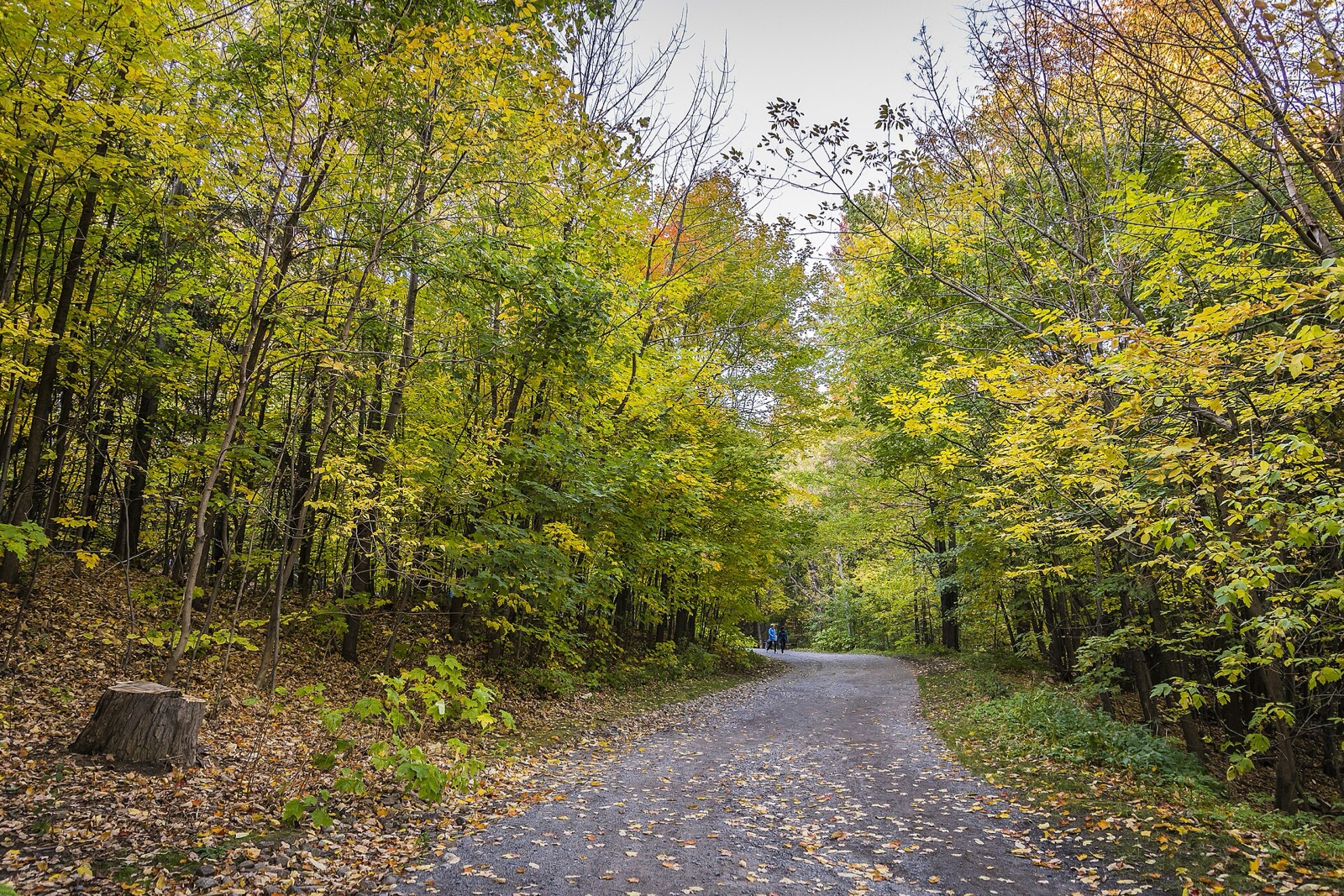
Mount Royal is the reason Montreal never has to leave town for fall color. Frederick Law Olmsted, co-designer of Central Park, laid out the park in the 1870s, and his central idea survives: a gravel carriage road, now called chemin Olmsted, that climbs the mountain at a grade gentle enough that you barely notice you are ascending through an unbroken hardwood canopy. In the first half of October that walk is a tunnel of sugar maple, red maple, and oak, and it delivers you to the Kondiaronk Belvedere, the stone terrace in front of the mountain chalet, where downtown's towers rise out of a foreground of color.
Kondiaronk faces south over the skyline; the Camillien-Houde lookout on the mountain's eastern shoulder faces the other way, across the Plateau's rooftops toward the Olympic Stadium, and it catches morning light that the chalet side does not. Between the two, Beaver Lake sits in a shallow bowl near the summit ringed by maples that reflect in the water on a still morning. The two cemeteries draped over the mountain's northern flank, Mount Royal and Notre-Dame-des-Neiges, hold some of the oldest and most varied trees in the city; both welcome respectful walkers, so keep voices low and stay on the lanes. On Sundays, as long as the weather holds, the tam-tam drummers still gather at the George-Étienne Cartier monument at the mountain's foot, and the lawn above them becomes the city's unofficial leaf-watching grandstand.
How the season moves through the city
Montreal's own window is October 10–October 14, 2026 (forecast), but the more useful mental model is a color front sliding south. It ignites first in the high country of the Laurentians, whose forecast window is September 4–September 24, 2026 (forecast), then rolls down to the St. Lawrence lowlands a week or two later. West of the city, Ontario's lake country runs on roughly the Laurentian schedule, not Montreal's, so a trip built around the city's peak will find the near-north past its best. The practical upshot: arrive early in the city's window and you can drive an hour north into full peak, then watch the same show arrive at Mount Royal a few days later. Arrive late and the Eastern Townships, sitting lower and slightly south, become your insurance policy. This is also why a fall weekend here rarely feels mistimed; something within ninety minutes of downtown is always near its moment.
The Botanical Garden's autumn runs two gardens deep
The Montreal Botanical Garden, across from the Olympic Stadium on the Pie-IX metro stop, is the city's second essential fall stop, and its two East Asian gardens do autumn in deliberately different registers. The Japanese Garden plays it quiet: a pond, pines held in careful silhouette, and Japanese maples that turn a deeper, more saturated red than the native sugar maples outside the walls, all composed for slow circling rather than a single viewpoint. The Chinese Garden, a Ming-style courtyard landscape built around its own reflecting pond, is theatrical by design, and each fall it becomes the stage for the garden's lantern event, when handmade silk lanterns are lit at dusk across the pavilions and water. Evening tickets sell out on peak weekends, so book ahead and come while there is still light to watch the garden shift from leaf color to lantern color. Beyond the walls, the arboretum's collections mean the garden holds interest for weeks on either side of the native peak, and the First Nations Garden ties the maple harvest back to the people who were tapping these trees long before there was a city here.
Streets worth walking in the Plateau and beyond
Montreal's residential streets carry the season as well as its parks. In the Plateau, Square Saint-Louis is the postcard: a Victorian square of painted row houses around a fountain, ringed by mature trees, with avenue Laval running off its corner under a full canopy. The Plateau's side streets stack the neighborhood's famous exterior staircases against front-yard maples, and wandering without a route is the correct method. Outremont, on the mountain's northern side, pairs its leafy avenues with the cafés and bakeries of avenue Bernard and avenue Laurier. Up the hill in Westmount, Summit Woods is a small forest reserve near the top of the western summit, with a lookout nearby that gives you the skyline from an angle most visitors never see. None of this requires a plan; it requires an unhurried afternoon and a bakery stop.
Water-level color on the Lachine Canal and the islands
For flat, easy mileage, the Lachine Canal bike path runs from the Old Port southwest through Saint-Henri, lined with cottonwoods and maples that double themselves in the still water between the locks. Bike share runs well into the fall, and Atwater Market sits right on the canal at the halfway point, its stalls stacked with squash, late apples, and maple products, which makes it the natural turnaround. Parc Jean-Drapeau, the two islands in the St. Lawrence one metro stop from downtown on the yellow line, flips the geometry: instead of looking out from the mountain, you look back at the city across the river with island woods in the foreground. It is the best skyline-plus-foliage view in Montreal at blue hour, and it stays uncrowded on weekday evenings.
Laurentians or Eastern Townships: picking your day trip
North or east is the real fall decision in Montreal. The Laurentians, roughly an hour and a half northwest, are the drama option: rounded, forested mountains, lake after lake, and Mont-Tremblant's village and hiking trails at the top of the corridor. The P'tit Train du Nord, a rail trail threading the whole valley through Val-David and Sainte-Adèle, is the region's gift to cyclists, and because of the elevation the color up here runs ahead of the city, so check September 4–September 24, 2026 (forecast) against your dates before committing. The Eastern Townships, an hour and change east, are the pastoral option: Lake Memphremagog, the trails of Mont-Orford, and villages like Sutton and Knowlton surrounded by orchards and a legitimate wine route. The Townships share their hills and sugar maples with Vermont directly across the border, at a fraction of the leaf-season traffic that funnels toward the border from Boston and the rest of New England.
Sugar shack culture, out of season
Visitors are often surprised to learn that the cabane à sucre, Quebec's sugar shack, is a spring institution, not a fall one. Sugaring-off happens when the sap runs, in the freeze-thaw weeks of late winter, and that is when families pack into wooden halls for maple-drenched feasts and taffy poured on snow. Come autumn most cabanes are dark, though a few well-known ones now run fall harvest menus built around apples and squash, and they book out fast. The reliable fallback is the markets: Jean-Talon in Little Italy and Atwater on the canal both sell maple syrup by the can alongside maple butter, maple sugar, and enough late-harvest produce to make the season edible. Buy syrup here rather than at the airport; the price and the grades on offer are better, and the vendors will explain the difference between a delicate early-run syrup and the dark, almost smoky late-run cans.
A weekend that works
Day one belongs to the mountain: up chemin Olmsted at opening, Kondiaronk before the tour groups, down past Beaver Lake, and an afternoon drifting the Plateau's squares and staircases with no agenda beyond bakeries. Day two pairs the Botanical Garden in the morning, when the Japanese Garden is quietest, with the Lachine Canal by bike in the afternoon and Parc Jean-Drapeau at dusk for the skyline. Day three is the day trip, north or east depending on where the front sits. Photographers should note the pattern: Camillien-Houde for sunrise, gardens in midday shade when the light goes hard, skyline from the islands at blue hour. The techniques in the fall foliage photography guide apply cleanly here, especially the parts about working reflections and overcast days, which Montreal supplies generously in October.
Montreal fall weekend kit
- Layers for cold mornings and mild afternoons
- Walking shoes with grip for wet leaves on gravel paths
- Bike-share app set up before you reach the canal
- Advance tickets for the Botanical Garden's lantern evenings
- An empty corner of your bag for market maple syrup
Chaining it with Quebec City
If you have more than a weekend, the elegant move is to ride the color front instead of chasing it. Quebec City sits downriver and runs earlier than Montreal, so starting there and finishing here stretches one peak into two. The train along the St. Lawrence connects the two in an afternoon, and the two cities read as different seasons of the same show: Quebec City is ramparts and wild valleys, Montreal is neighborhoods and gardens. Done in order, you get both at their best.
Things to do in fall in Montreal
Orchards, cider, haunts, and harvest season. These are the iconic fall stops within a day trip of Montreal.
Nuit de Terreur (Night of Terror)
Haunted attractionColor nearby peaks October 13
A haunted house in Laval, a short drive north of downtown Montreal, that rebuilds its maze and story each Halloween season.
Vergers Petit & Fils
32 kmOrchard
Color nearby peaks October 11
A 50,000-tree orchard at the foot of Mont-Saint-Hilaire on Montreal's South Shore, picking ten apple varieties from Melba to Honeycrisp…
in Québec — Laurentians & Eastern Townships
Orchard
Color nearby peaks October 11
Founded in 1981 and now run by the third generation of the Charbonneau family at the foot of Mont-Saint-Gregoire.
in Québec — Laurentians & Eastern Townships
Orchard
Color nearby peaks October 11
A family cider house at the foot of Mont-Saint-Grégoire, picking apples here since the orchard was planted around 1950 and run by the…
in Québec — Laurentians & Eastern Townships
Orchard
Color nearby peaks October 11
Cistercian monks run this u-pick apple and pear orchard on the slopes of Mont Rougemont, open Wednesday through Sunday from early September…
in Québec — Laurentians & Eastern Townships
Orchard
Color nearby peaks October 11
A cider house on the slopes of Mont Rougemont, the heart of Quebec's apple country east of Montreal, making crackling, still and sparkling…
in Québec — Laurentians & Eastern Townships
Guides
2026 Fall Foliage Forecast: When Leaves Peak in Every State
Our 2026 fall foliage forecast for the US and Canada, region by region, built from ERA5 weather data and a phenology model, with live peak dates on the map.
What's New: A Map of 465 Fall Destinations
Autumn Guide's Explore hub now covers 465 spots worldwide (orchards, scenic drives, hikes, and festivals) with category pins, live status, and a near-me search.
The Best Fall Hikes in New England
Eight trail-tested fall hikes across Vermont, New Hampshire, Maine, and Massachusetts, from short overlooks to a full above-treeline ridge walk.
5 Leaf-Peeping Road Trips for 2026
Five real fall road trips for 2026, from Vermont's Route 100 to Germany's Alpine Road, with route feel, standout stops, and how many days to plan for each.
Frequently asked
- When do leaves peak in Montreal in 2026?
- Peak color is predicted for October 10–October 14 (best estimate October 12). Color starts around September 29 and trees are mostly bare by November 1. These dates are computed for Montreal itself, at 76 m elevation, using the same weather model as the tracker.
- When is fall foliage season in Montreal?
- Montreal colors during autumn (September to November). Counting from the first turn to bare branches that is about 33 days, and the best of it falls in the week either side of October 12.
- What's the best foliage near Montreal?
- Parc national du Mont-Orford (109 km); Mont-Tremblant, Panoramic Village (112 km). For a longer trip: Québec — Laurentians & Eastern Townships (732 km, peak ~September 14); Ontario — Algonquin & Muskoka (989 km, peak ~October 6); Vermont (173 km, peak ~October 9).
- What are the best things to do in fall in Montreal?
- Beyond the leaves: Nuit de Terreur (Night of Terror) (19 km); Vergers Petit & Fils (32 km); Vergers et Cidrerie Denis Charbonneau (37 km); Cidrerie Verger Léo Boutin (37 km); Verger de l'Abbaye de Rougemont (40 km). All of them are mapped on this page.
- When do the leaves change color in Montreal?
- The city itself typically peaks in early to mid October, with Mount Royal and the big parks holding color into the back half of the month in a mild year. The Laurentians north of the city turn earlier, usually from late September, so a well-timed trip can catch both.
- Is Mount Royal good for fall foliage?
- It is the single best place in the city. The park is a forested mountain designed by Frederick Law Olmsted, and the gravel carriage path up to the Kondiaronk lookout runs through continuous hardwood canopy. Go at opening on a weekday for the quietest walk.
- Should I day-trip to the Laurentians or the Eastern Townships?
- The Laurentians give you bigger hills, earlier color, and classic lake-and-forest views; the Eastern Townships give you villages, orchards, and wineries at a gentler pace with color that lingers later. If your visit lands early in the season, go north; later in the season, go east.
- Are sugar shacks open during fall in Quebec?
- Traditional sugaring-off season is late winter and early spring, when the sap runs, so most cabanes à sucre are closed in autumn. A handful run fall harvest menus, and the city's public markets sell maple in every form year-round, so you will not leave without tasting the season.
- Do I need a car for fall colors in Montreal?
- Not for the city: the mountain, the Botanical Garden, the Lachine Canal, and Parc Jean-Drapeau are all reachable by metro, bus, or bike share. A car makes the Laurentians and Eastern Townships far easier, though bus service does reach the main towns in both regions.