Foliage Timing & Seasons
What Is Peak Foliage? How Peak Is Defined and Forecast
By Benjamin Janes · Published
· 5 min read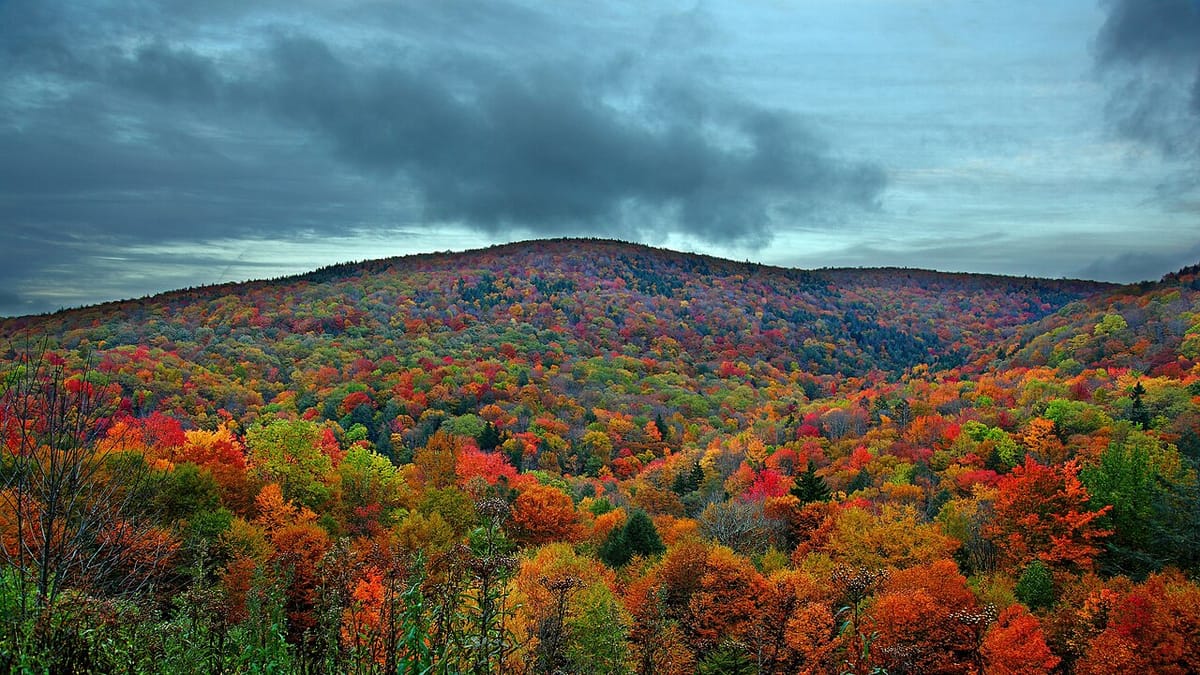
Peak foliage sounds like it should mean the single best day, the one afternoon a hillside looks its absolute reddest. That's not quite what forecasters mean by it, and knowing the real definition changes how you should read a forecast window.
A canopy average, not a single tree
Peak describes the point when the widest share of a region's tree canopy is showing full color at once, not the moment any one spectacular maple looks its best. A single early tree can be gorgeous weeks before the region around it peaks, and a single late oak can still be holding green well after peak has technically passed. Neither of those outliers moves the actual peak date, because peak is measuring the whole canopy, many species and thousands of individual trees, averaged together. That is also why peak is not the same thing as "most leaves have fallen." A canopy can be at its fullest, most saturated color and still be holding almost all of its leaves; peak comes before the drop, not after it.
Think of a single hillside in Vermont made up of sugar maple, birch, and a scattering of ash. The maples might already be a deep orange-red while the birch is still mostly yellow-green and the ash has barely started. None of those three is wrong about where it stands in its own schedule. Peak for that hillside is the point where the combined mix looks fullest and most saturated as a whole, which usually lands somewhere in the middle of each individual species' own timeline rather than at the exact peak of any one of them.
Why peak is a window, not a day
Because it is an average across so many trees, peak rarely lands on a single day. Different species within the same region cross their own thresholds a few days apart from each other, and a mix of maple, birch, and oak on the same hillside can be at slightly different points in the process even during the "peak" stretch. That is why October 7–October 11, 2026 (forecast) renders as a range rather than a single date. The window represents the stretch when the region as a whole looks its fullest, and a trip landing anywhere inside that window should catch strong color, even if the very best single day happens to fall a bit earlier or later within it. Treat the edges of that window as real too, not just padding around a hidden "true" date. A trip on the first day of the window can still mean strong color already established on the earliest species, with more still building behind it.
How a forecast model actually gets there
A useful peak forecast starts with the same trigger that starts the season: night length, which is fixed and predictable years in advance for any given latitude. From there, the forecast layers on real weather data, since temperature trends after the trigger fires determine how quickly the visible color builds and how long it holds before wind or rain strips it. Grid-sampled weather across a region lets a model estimate that build-up location by location rather than guessing at a single number for an entire state. The interactive map is built around exactly that kind of grid sampling, which is also why the forecast window sharpens as a trip gets closer. Early in the season, a forecast is closer to a typical-year estimate; by the final couple of weeks, it is responding to the weather that actually happened.
Region peak vs. city peak
A region's peak window and a specific city's peak window are not automatically the same thing, because cities sit at their own elevation and latitude, sometimes tucked in a warmer valley or a cooler pocket relative to the wider region around them. October 20–October 24, 2026 (forecast) reflects conditions sampled at the city itself, which can run a little later than a colder inland region nearby, or a little earlier than a milder coastal spot. Urban heat also plays a small role: streets, buildings, and parking lots hold warmth overnight, which can push a city's own trees to color a few days behind a park or forest just outside town at the same latitude. That distinction matters most for anyone planning a trip that mixes city time with a drive out to see foliage in the surrounding countryside; the two windows are related but worth checking separately rather than assuming they line up exactly.
Peak on a ridge vs. peak in the valley
Even within a single region, elevation shifts peak in the same way it shifts the start of the season. A high ridge in Colorado can reach peak well before a low valley only a short drive away, since colder air at altitude speeds up the chemistry once the trigger has fired. A region-wide peak window is, in effect, an average across many of these smaller peaks happening at slightly different elevations and slightly different times. That is worth remembering if a region's forecast window feels like it doesn't match what you're seeing from a specific trailhead: the number is describing the region as a whole, not that one spot. Why fall color moves south and downhill covers that elevation effect in full, including why it moves faster over a mile of climbing than over a much longer drive north.
What to trust when forecasts disagree
If two sources disagree on when a region will peak, lean toward whichever one is more recently updated and grounded in actual current weather rather than a fixed historical average. Weather is the variable that swings a forecast the most from one year to the next, and the weather that makes or ruins a foliage year goes into exactly which conditions push a peak earlier, later, or shorter than usual. A forecast window is your best available estimate, not a guarantee, and it gets more trustworthy the closer you get to your actual travel dates rather than less.
It also helps to remember what a forecast can't do: it can't tell you that a specific tree on a specific trail will look perfect on a specific afternoon. What it can do is narrow a wide, uncertain season down to a realistic window worth planning around, and point you toward the region, or the elevation within that region, most likely to be near its best when you actually have time off to travel. That is a more useful promise than a single date, even if it feels less tidy on a calendar.
Frequently asked
- What does peak foliage actually mean?
- Peak foliage is the point when the widest share of a region's tree canopy is showing full color at the same time, rather than the single most vivid tree or the single most colorful day. It is a canopy-wide average, which is why forecasts describe it as a window rather than one date.
- Why is peak foliage given as a date range instead of one day?
- Because peak describes a broad average across many trees and species that don't all turn in perfect unison. Some species and locations reach their best color a few days before others nearby, so the window when a region looks its fullest typically spans a week or more, not a single afternoon.
- How is a peak foliage forecast calculated?
- Forecast models track the same night-length trigger that starts the season, then layer on real weather data such as temperature trends to estimate how quickly the color will build and how long it is likely to hold. The result is a projected window that updates as the actual weather comes in.
- Does peak foliage happen at the same time across an entire region?
- No. Elevation, latitude, and local microclimates mean peak can arrive at different points across a single region, sometimes by a couple of weeks between a high ridge and a low valley. A region's forecast window is an average across many locations, not a promise that every spot peaks on the same day.
- Should I trust a peak foliage forecast made weeks in advance?
- Treat an early forecast as a reasonable planning estimate, not a fixed date, and check again as your trip gets closer. Forecasts sharpen considerably in the final couple of weeks, once the model has real, current weather to work with instead of a typical-year estimate.
Regions in this article
More in Foliage Timing & Seasons
Foliage Timing & Seasons
False Fall: Why Some Leaves Turn in Late Summer
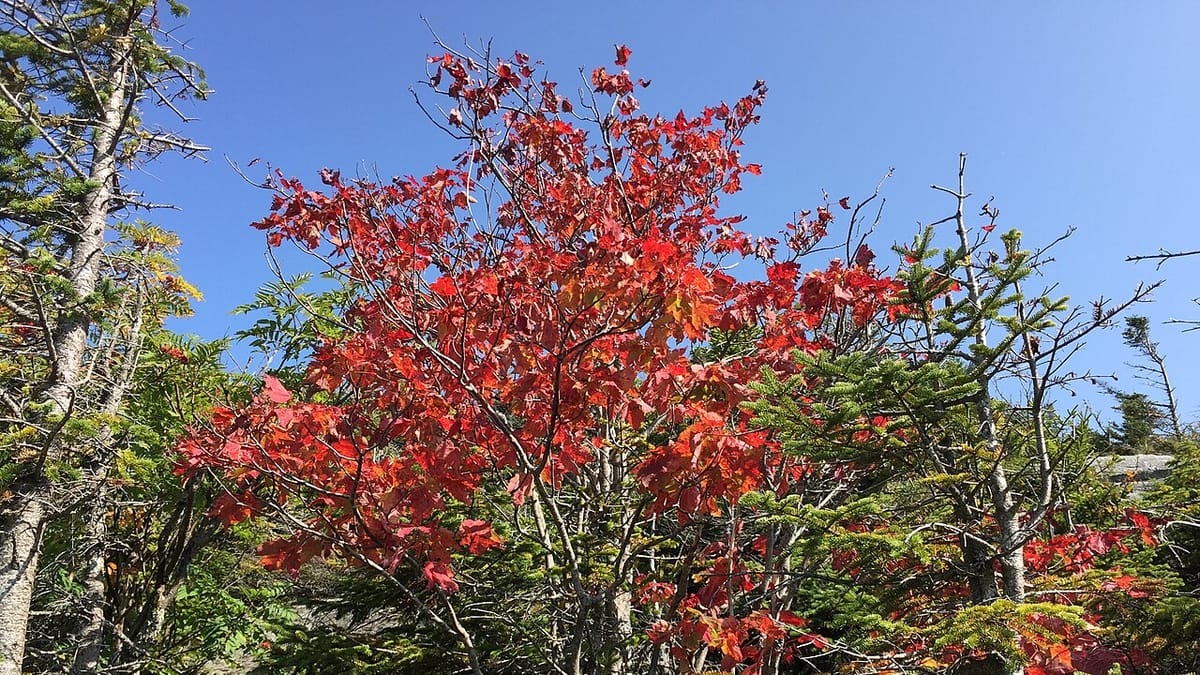
Red leaves in late summer usually aren't an early fall. They're almost always a stressed tree reacting to drought, damage, or disease.
2026-07-17 · 5 min read
Foliage Timing & Seasons
How Fall Foliage Forecasts Actually Work
Fall color forecasts combine a fixed seasonal trigger with weather that has to be estimated. Here's how the underlying model actually predicts a peak.
2026-07-18 · 6 min read

Foliage Timing & Seasons
The Weather That Makes (or Ruins) a Great Foliage Year
Warm days, cool nights, and just enough rain make a vivid fall. Drought, wind, and an early hard freeze can flatten the same season fast.
2026-07-17 · 5 min read