Leaf Science
How Trees Know It's Autumn: The Science of Shorter Days
By Benjamin Janes · Published
· 8 min read
A tree never checks a thermometer, and it doesn't wait for the first frost to end its summer. It counts the dark. A pigment in every leaf tracks how long each night runs, and once enough long nights stack up in a row, the tree throws the hormonal switch that starts fall, weeks before any real cold shows up.
The clock isn't the thermometer
Ask someone on a trail what causes the color to turn and most people will blame the cold. It's a fair guess. Cold nights and color change tend to show up in the same weeks, so it looks like cause and effect. But the two are only riding together. Foresters have known for a long time that the real trigger is photoperiod, the shifting ratio of light to dark across each day. A tree at a given latitude starts shutting down within roughly the same stretch of the year whether the summer before it was scorching, mild, or soggy.
That fixed schedule is easy to check for yourself. A sugar maple on a warm, sheltered slope and one on an exposed, windy ridge nearby will begin changing within days of each other, even though the ridge tree has felt colder nights all summer. What they share isn't temperature. It's a night of nearly the same length, because they sit at almost the same latitude under almost the same sun. Meanwhile an oak thirty feet away, a different species with a different threshold, can sit fully green for weeks after the maples have turned. Same weather, same soil, different internal clock.
Night, not day: how phytochrome keeps time
The mechanism behind that clock is a pigment called phytochrome, and it behaves less like a light switch and more like an hourglass. Phytochrome exists in two forms. Red light near dawn and dusk flips it into an active state. Left alone in darkness, that active form slowly decays back to its resting state at a fixed rate, hour by hour.
During the short nights of summer, darkness never lasts long enough for that decay to finish before sunrise resets the pigment again. As nights stretch out through late summer, there's more uninterrupted dark for the decay to run its full course. Once a leaf has logged enough consecutive long nights, a threshold that differs by species, phytochrome reports back that the nights have gotten long, and that reading kicks off the hormonal chain behind leaf drop. Plant scientists actually talk about critical night length rather than day length, because darkness is what the pigment is measuring. The response was first mapped out decades ago in flowering plants like cocklebur and chrysanthemum, long before anyone confirmed the same clock runs inside a maple or an oak. Everyone still talks about "shortening days" because that's the part we notice standing outside.
A threshold written into every species
Not every tree needs the same length of night to trip its switch. That's why a single hillside can show early color in the aspens while the oaks nearby are still fully green weeks later. Species that evolved farther north, or higher up a mountain where the growing season runs short to begin with, tend to need less darkness to read the fall signal. They shut down quickly. Species built for a long growing season hold out for more consecutive long nights before they commit.
Genetics travels with the tree as well. Plant two maples of the same species side by side in the same yard, one grown from seed collected far north and one from seed collected much farther south, and they will trigger at noticeably different points in the season. Nurseries have learned to plan around exactly this when they source stock for a given climate. A tree reads more than the sun overhead. It runs a program calibrated to wherever its ancestors happened to grow, generations before this particular tree ever took root. That same genetic memory decides more than just timing, too. It's a big part of why one maple on a street can turn brilliant scarlet while its neighbor, the same species, planted the same year, finishes the season plain yellow, a split covered in more detail in why some maples turn red and others yellow.
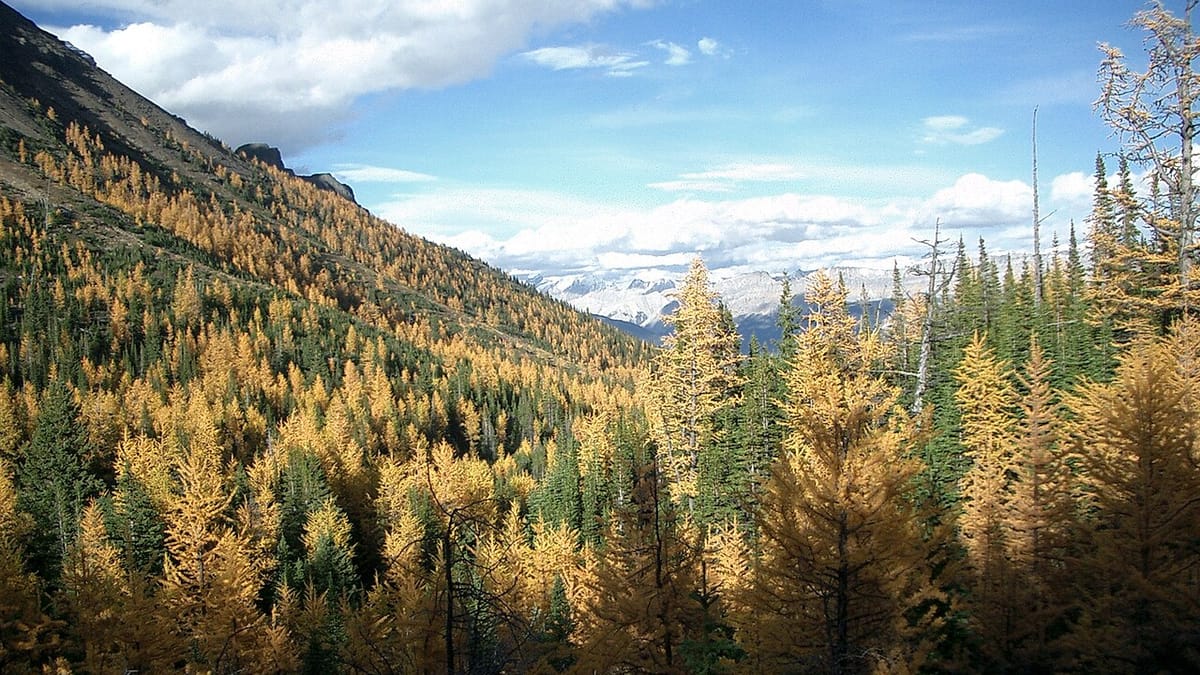
Conifers mostly skip this calculation, holding their needles straight through the trigger point year after year. A few exceptions break the rule on purpose: tamarack and other larches run the same phytochrome program a maple does, and drop every needle each fall despite looking, for eleven months of the year, like any other evergreen on the ridge. The cost-benefit math behind why most conifers opt out of the whole leaf-drop calculation, and why larches opt back in, is its own story, laid out in evergreen vs. deciduous.
Sealing the door: the abscission zone
Long before a leaf visibly changes, a second process starts at its base. A narrow band of cells where the leaf stem meets the branch, called the abscission zone, responds to that same phytochrome-triggered hormone shift: auxin from the aging leaf declines, ethylene from the tree rises. Enzymes in that band start dissolving the pectin that glues neighboring cell walls together, one layer at a time, loosening the leaf's grip on the branch without yet cutting off its plumbing.
At the same time, the tree builds a protective, corky layer on the branch side of that same zone, sealing the wound before the leaf is even gone. That's why a leaf dropping from a healthy tree in fall leaves no open wound behind it, and why a tree can shed tens of thousands of leaves in a season without inviting rot or disease into every scar.
Pick up a fallen leaf sometime this season and look at its stem. The break is clean, almost machined, nothing like the ragged tear you get pulling a leaf off a living branch in midsummer. That crisp edge is weeks of cellular work, finished right on schedule, not a wound at all.
Not every species finishes that seal on the same schedule, though. Walk past a young oak or beech in the dead of winter and you'll often find it still hung with dry, brown leaves that never quite let go, because its abscission zone stalled out partway through the process instead of finishing cleanly in fall. That trait has a name, marcescence, and its own set of unresolved explanations, covered in marcescence: why oaks and beeches keep dead leaves all winter.
The rest of the woods is counting too
Phytochrome isn't a leaf-only trick. The same night-length math that starts a maple's shutdown also nudges geese into their first long flights south, pushes black bears toward heavier feeding before den season, and triggers the coat change in a snowshoe hare well before the first real snow falls. None of those animals are guessing at the weather any more than the trees are. Birds, mammals, and trees are all running some version of the same old calculation: count the dark, act on the count.
That's worth remembering on a hike, because it means a whole hillside is working off one schedule even when it doesn't look that way from a single trailhead. The maples turning color, the geese stacking up overhead in loose lines, a chipmunk suddenly frantic about a stash of seeds it's been ignoring all summer: different species, different responses, the same clock running underneath every one of them.
Why the calendar beats the weather forecast
Because the trigger is photoperiod and not temperature, the start of fall behaves like an astronomical event rather than a weather event. It's tied to latitude and the tilt of the earth, both fixed and predictable years ahead, rather than to whatever the atmosphere decides to do in a given year. A warm, late-hanging Indian summer can push the daytime highs well past what feels seasonal, and the maples will still start their shutdown on schedule underneath it, because the leaves are reading the night, not the afternoon.
The same fixed clock is also why color sweeps across a map in a fairly predictable order. Night length grows a little faster the farther north you sit, so a ridge near the northern edge of a region crosses its threshold before a valley well to the south does, even within the same stretch of the calendar. Elevation adds a second layer through a different channel entirely: temperatures at altitude run consistently colder, which speeds up the downstream chemistry once the trigger has already fired. That's why a mountaintop can look well ahead of the valley floor below it in its color change, even though both crossed the actual photoperiod threshold around the same time.
What weather actually controls is everything downstream of that trigger: how saturated the reds and oranges get, how long the display holds before wind and rain strip it, how compressed or drawn out the whole show ends up looking. A run of warm, sunny days after the trigger fires can produce a spectacular few weeks. A stretch of gray, humid nights over that same window can leave the same trees dull and brown early, even though every one of them started shutting down on the same night-length schedule as always. For the chemistry behind what actually paints those colors once the shutdown begins, the full science of why leaves change color covers the pigments in full, and leaf pigments explained goes a layer deeper into why yellow was hiding in the leaf all along while red gets built fresh every autumn. What's described here is only the trigger that starts that chemistry running in the first place.
Watching the clock on the trail
Once you know what's actually running the season, fall stops feeling random. Stand on a ridge in Vermont in late summer and you can watch a whole hillside of sugar maple sitting green under a sky that already feels different: lower light, longer shadows, gold creeping in hours before sunset. That's not your imagination. Every leaf on that hillside is reading the same cue you're standing in.
Head north into New Hampshire and the whole calendar shifts earlier: same trigger, higher latitude, less darkness needed to trip it. If you want to watch that front build in real time instead of guessing at it, Vermont's region page tracks the live forecast for exactly this kind of ridge, and the interactive map follows the whole photoperiod-driven wave as it moves down the continent through fall. Weather can dim the show or brighten it, but it doesn't get a vote on when the show starts.
Frequently asked
- How do trees know when to drop their leaves?
- Trees measure the length of uninterrupted darkness each night using a pigment called phytochrome. Once nights stay long enough for several nights in a row, that reading triggers hormonal changes that start leaf senescence and open the abscission zone at the base of each leaf stem, regardless of the day's temperature.
- Is it temperature or daylight that triggers fall color?
- Daylight, or more precisely the length of night, is the trigger. Trees at a given latitude begin shutting down within roughly the same window every year regardless of whether the season ran warm or cool. Temperature mostly shapes how vivid the color gets and how long it lasts, not whether the process starts.
- What is the abscission zone?
- The abscission zone is a narrow band of cells where a leaf stem meets the branch. In fall, enzymes there dissolve the pectin holding cell walls together while the tree builds a protective layer beneath it, so the leaf can separate cleanly without leaving an open wound on the branch.
- Can artificial light delay a tree's fall color?
- Yes. Streetlamps and other night lighting interrupt the uninterrupted darkness a tree's phytochrome needs to register long nights. Trees growing near strong artificial light often hold their green well past nearby trees of the same species growing in genuinely dark conditions, because their internal night-length count keeps resetting.
- Why does fall color start on schedule every year no matter the weather?
- The trigger, night length, is tied to latitude and the earth's tilt, both fixed and predictable years in advance. Weather varies constantly and affects the color's intensity, but it doesn't set the start date, so the same ridge tends to begin changing within days of the same point on the calendar most years.
Regions in this article
More in Leaf Science
Leaf Science
Anthocyanins, Carotenoids, and Chlorophyll: Leaf Pigments Explained
Yellow and orange leaves were hiding under the green all summer. Red is different: most trees build that pigment fresh every fall. Here's the chemistry behind both.
2026-07-17 · 4 min read
Leaf Science
Evergreen vs. Deciduous: Why Some Trees Keep Their Leaves
Dropping every leaf each fall looks wasteful, and keeping them through winter looks risky. Both strategies work, and the tradeoff comes down to leaf economics.
2026-07-17 · 4 min read
Leaf Science
How to Identify Trees by Their Fall Leaves
A field method for naming trees by autumn leaves: check the branching pattern first, then leaf shape, then color, and most common species sort themselves out fast.
2026-07-18 · 6 min read