Photography & Observation
Beyond the Postcard: Photographing Autumn's Small Details
By Benjamin Janes · Published
· 4 min read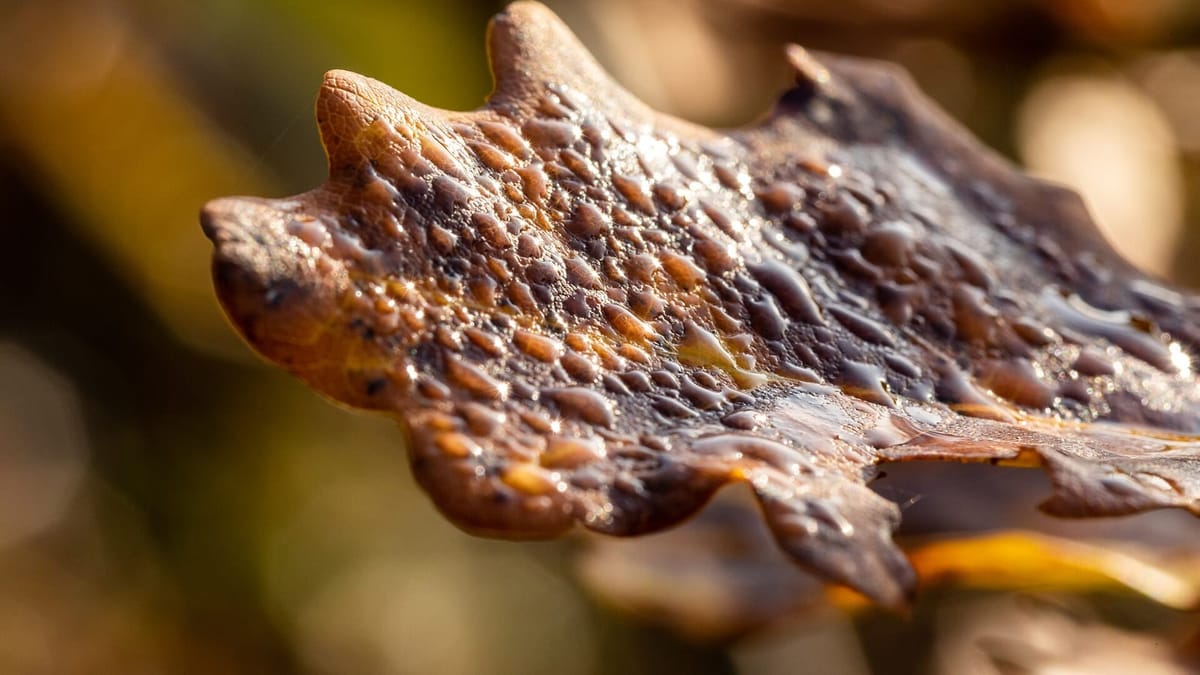
The photo everyone takes is the whole hillside from a pullout. The photo worth taking might be a single leaf, a frost-rimmed edge, a puddle holding an upside-down tree. Autumn's small details reward a slower kind of looking, and most of them are sitting a few feet off the trail everyone else is walking past.
Why the wide shot rarely holds up
Every fall road trip produces the same picture: a hillside from a scenic pullout, packed edge to edge with color and somehow still flat once you look at it back home. Our field guide to fall foliage photography gets into why, a wide, undifferentiated scene rarely gives the eye anywhere to land. Detail shots solve that a different way. Instead of finding one strong subject inside a big scene, you make the small thing the whole scene. A single leaf fills the frame on its own terms, and nothing competes with it.
One leaf, held up to the light
Pick a leaf still on the tree, not one already down and curling, and hold it up between your eye and the sun, or crouch so a low branch backlights it naturally. Thin fall leaves are close to translucent, and light passing through shows off vein structure and color gradients a straight-on shot from a few feet away completely misses.
You don't need a dedicated macro lens for this. Most phone cameras have a close-focus mode that kicks in automatically once you get within a few inches of a subject, and a basic camera lens can usually focus closer than people expect if you just try it before assuming you need special gear. Fill the frame with the leaf and nothing else. Any hint of background clutter, a parking lot, another hiker's boots, pulls attention straight off the thing you walked over to look at.
Frost's window is short, so plan around it
Once the season's first frosts arrive, a clear, calm, cold night leaves ice crystals traced along every leaf edge and vein by morning, the same still, radiative conditions that produce fog on a more humid night. Frost outlines a leaf's structure the way backlighting does, just in white instead of gold, and it's often most striking on leaves already partway through their color change, red or orange showing through a rim of white.
That window doesn't last. Direct sun clears frost off an exposed leaf within roughly an hour of reaching it, faster in open fields than in shaded hollows, so this is a shoot you plan an early start around rather than one you stumble into midmorning. Shaded, low-lying spots away from direct sun hold their frost longest, which makes them worth a special trip even after the more exposed parts of a trail have already gone bare and wet.
Small reflections: puddles, dew, and still eddies
Our companion guide covers big, glassy lake reflections, but the same trick works at a much smaller scale, and it's often easier to find. A puddle in a dirt road can hold a near-perfect upside-down reflection of the branches overhead. A still eddy tucked behind a rock in an otherwise moving stream will mirror the bank beside it. A single drop of dew sitting on a leaf's surface acts like a tiny lens, holding a miniature, upside-down version of the sky and canopy inside one bead of water.
Get low for all of these, closer to the ground than usually feels necessary, and check the water's surface for wind ripple before you commit to a shot. Even a light breeze breaks a reflection apart faster than you'd expect.
Bark, seed pods, and the textures everyone walks past
Color gets all the attention, but fall texture is everywhere once you start looking: peeling curls of birch bark, a cluster of acorns still in their caps, lichen spreading in flat gray-green patches across a stone wall. Damp, mossy stretches of trail, common in the Pacific Northwest around Washington, turn bigleaf maple trunks into small landscapes of their own, moss and lichen and bark all layered together, worth a photo entirely separate from whatever the canopy above is doing. Farther east, the shaded coves of North Carolina hold the same kind of texture in wet stone and fern.
None of this needs a colorful backdrop. A gray, overcast sky, the same soft, even light that makes a wide hillside shot work, is often the best possible light for close, textured detail, since it doesn't throw a hard shadow across every ridge and groove.
A tradition that already treats detail as the point
This kind of close attention isn't a fallback for a disappointing wide view. It's the actual point of an entire travel tradition. In Japan, Kyoto's temple gardens are built for exactly this kind of looking, moss gardens where visitors crouch to study a single fallen leaf, maple branches pruned for decades to frame one view at a time rather than a whole hillside. Momijigari, Japan's centuries-old practice of leaf hunting, treats a single perfect leaf as worth the entire trip. You don't need a Kyoto garden to borrow the habit. You just need to stop walking and look at the thing in front of you instead of the view behind it.
Before a detail-focused walk
- Go slow and get low, most small subjects sit under eye level
- Backlight a single leaf instead of shooting it flat-lit
- Check water surfaces for wind before shooting a small reflection
- Save detail shots for overcast light when you can
- Clear the background before you shoot, not after
Frequently asked
- What makes a detail fall photo different from a landscape shot?
- A detail shot makes one small thing, a single leaf, a frosted edge, a puddle reflection, the entire subject, rather than one element inside a wide scene. It usually needs less light and less travel than a landscape shot, since the subject is often a few feet off the trail.
- Do I need a macro lens to photograph a single leaf well?
- Not usually. Most phones have an automatic close-focus mode, and standard camera lenses can often focus closer than people assume. Fill the frame with the leaf, remove background clutter, and backlight it if you can; framing and light matter more than the gear.
- How long does frost stay on leaves after sunrise?
- Not long, often under an hour once direct sun reaches an exposed leaf, though shaded or low-lying spots hold frost noticeably longer. Plan an early start on a clear, calm, cold morning, and save shaded hollows for last since they keep their frost after open ground has cleared.
- Is overcast light good for macro and detail photography?
- Yes, often better than direct sun. Even, diffused light avoids the hard shadows and glare that direct sun throws across small textured subjects like bark, moss, or a single leaf, which makes an otherwise dull gray day a strong choice for close detail work.
- Where can I find good detail shots if the canopy isn't at its best yet?
- Anywhere with texture: bark, lichen, seed pods, puddles, and mossy stone all hold up regardless of how much color is currently on the trees. Detail photography is a reliable plan B on a trip where the wide views haven't quite peaked.
Regions in this article
More in Photography & Observation
Photography & Observation
Editing Fall Foliage Photos: A Simple Workflow
A repeatable fall foliage editing workflow: fix white balance, recover exposure, add contrast, and use vibrance instead of saturation so color stays believable.
2026-07-18 · 6 min read
Photography & Observation
Fall Foliage Photography: A Field Guide
How to photograph fall foliage well: overcast versus golden hour, polarizer technique, backlighting, fog, water reflections, and phone camera tips that work.
2026-07-14 · 5 min read
Photography & Observation
How to Keep a Foliage Journal: Notes, Photos, and Phenology
A short, consistent log of what a season really looked like beats memory every time. How to track color change and weather, and compare your notes year to year.
2026-07-17 · 5 min read