When do the leaves change in Kyoto?
Kyoto's momiji season is one of the world's great autumn spectacles: twelve hundred years of temple gardens designed around the November blaze of Japanese maples, from Tofuku-ji's valley of red to lantern-lit night viewings.
Peak: November 15–December 2
Climatological window from published records. The weather model doesn’t cover Japan yet, so this is the long-run normal rather than a season-specific forecast.
Fall activities in Kyoto
Kansai — Kyōto & Nara
28 kmRegion guide & timing
Kyoto's temple gardens turn in a famously precise sequence each November, while Koyasan's cedar-maple mix and the Lake Biwa shoreline extend the region's color for weeks.
Japanese Alps — Chūbu
257 kmRegion guide & timing
Central Honshu's high peaks lead Japan's main-island color, from Kamikochi's valley larch and the Tateyama Kurobe Alpine Route down to Nikko's shrines and the Fuji Five Lakes.
Kyūshū & Western Japan
446 kmRegion guide & timing
Western Japan's volcanic peaks and river valleys turn color latest in the archipelago, from Kirishima and Aso's crater slopes to Miyajima's Momijidani valley and Shikoku's Iya Gorge.
Where locals go
Kiyomizu-dera
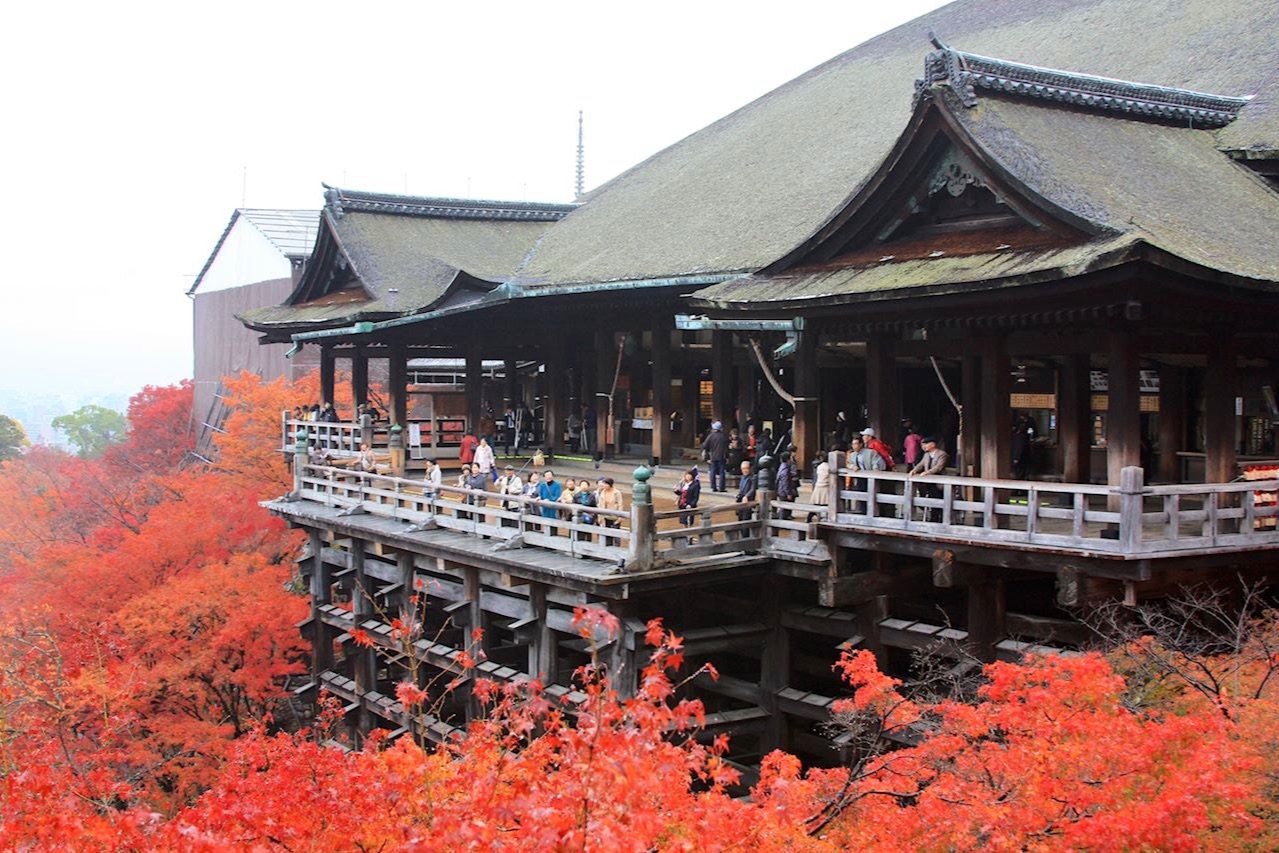
GardenThe wooden veranda of this UNESCO temple juts over a hillside of maples above Kyoto, lit for night viewing during peak color in mid-to-late…
Tofuku-ji
GardenKyoto's largest Zen temple complex hides a maple-choked ravine crossed by the wooden Tsutenkyo bridge, the shot that anchors most magazine…
Kyoto Momiji Season: A Temple-Garden Strategy
Kyoto's momiji season rewards strategy over stamina. These gardens were composed for particular hours of light, the night illuminations run on their own clock, and the crowds move in waves you can predict. This guide covers how to work all three, what to eat while you do it, and a three-day shape that survives peak weeks.
Work the light: west in the morning, east in the afternoon
Kyoto's geography does half your scheduling for you. Arashiyama sits against the western hills, and its maple slopes above the Hozugawa catch sun early, while the river valley is still quiet. The eastern chain, from Kiyomizu-dera down through Kodai-ji, Nanzenji, and Eikando, backs up against the Higashiyama ridge, so those gardens hold their glow into late afternoon, when low light rakes across the city and lands squarely in the maple canopies. Plan west-side mornings and east-side afternoons and you spend the whole day looking at leaves with the sun behind them, which is when momiji does its stained-glass trick. An overcast day is not a loss, either: flat light saturates the reds and lets you shoot the classic gravel-and-maple compositions without blown highlights. Backlighting, exposure, and working around other people's shoulders are covered in the fall foliage photography guide, and nearly all of it transfers directly to temple gardens. Keep in mind that the city's own color window, November 15–December 2 in a typical year, lands near the tail of Japan's national season, so mornings can be genuinely cold and the sun stays low and photogenic for most of the day.
Paid gardens worth every yen
Most of the marquee gardens charge admission, several raise the price in autumn, and the best are worth it without hesitation. Tofukuji's ticketed Tsutenkyo section puts you on a bridge over a ravine planted wall-to-wall with maples, the single most famous view of the season. Eikando pairs thousands of maples with a reflecting pond and a hillside pagoda, and its autumn surcharge buys the densest color in the city. Rurikoin, north in the Yase hills, is famous for one image, maples reflected in a dark lacquered table, and prices itself at several times a normal temple fee with advance timed tickets; decide how much that photograph matters to you before committing a slot to it. Smaller paid gardens like Enko-ji and Genko-an trade scale for composition, framing single maples in windows and doorways, and their fees buy you room to breathe that the famous names cannot. Bring cash. Many temple gates still do not take cards, and the coin tray moves faster than you expect.
The free color between the temples
Free Kyoto autumn is genuinely good, not a consolation prize. Nanzenji's outer grounds, including the hulking Sanmon gate and the brick aqueduct behind it, cost nothing; only the sub-temples and the gate climb charge. The Philosopher's Path strings maples and camellias along a canal for a couple of kilometers between Nanzenji and Ginkakuji, and Honen-in's mossy thatched gate, a minute off the path, frames raked sand terraces under the trees. The Kyoto Imperial Palace park is a broad, open counterpoint to the walled gardens, with big ginkgo and zelkova going gold above gravel avenues. Shimogamo Shrine's Tadasu no Mori forest turns famously late, holding color after the marquee gardens have thinned. Build your walking days so the paid stops sit like beads on a free string, and the day's rhythm improves along with its budget.
Arashiyama or the eastern hills
With one full day, choose by temperament. Arashiyama's front, the bamboo grove and Togetsukyo Bridge, is mobbed by mid-morning, but its reward structure deepens as you walk: Jojakko-ji's maple staircase, Gio-ji's tiny moss garden, and the preserved street running up to Adashino Nenbutsu-ji each shed another share of the crowd. Okochi Sanso, the hilltop villa garden above the grove, includes matcha and a sweet with admission and looks back over the whole valley. The eastern hills are a chain you can walk end to end: start at Kiyomizu-dera, drop through the preserved lanes of Sannenzaka and Ninenzaka to Kodai-ji, cross Maruyama Park, then follow the base of the hills north to Nanzenji, Eikando, and the Philosopher's Path, with a detour up to Shinnyo-do, whose grounds are free and reliably brilliant. The east gives you more variety per hour on foot; Arashiyama is the better half day if you arrive early and commit to going deep rather than lingering at the front.
Night illuminations: how the queue actually works
Several temples, Eikando, Kiyomizu-dera, and Kodai-ji among them, clear their grounds at the end of the daytime session and reopen after dusk as a separately ticketed illumination. The mechanics matter. Because of the changeover, a line starts forming before the evening gates open, and the first hour is the crush, since everyone who queued enters at once. Two approaches work: be near the front before opening and move through in the first wave, or arrive an hour or more into the session, after that wave has cycled out. Weeknights are meaningfully calmer than weekends, enough to be worth rearranging a day around. Buy advance or timed tickets wherever they are offered; same-day queues at Eikando and Kiyomizu-dera during peak color routinely swallow an hour of your evening. Tripods are banned at essentially every night session, so practice bracing against railings and using the reflecting ponds, which double the light you have to work with.
The famous spots that earn their crowds
Some names deserve their lines. Tofukuji at opening is still the best single view in the city, and the difference between the first entry and an hour later is the difference between a bridge and a platform queue. Kiyomizu-dera opens earlier than almost anything else in Kyoto, and its veranda over a maple valley at first light is worth the alarm. Eikando at night is the finest illumination in the city, everyone knows it, and you should go anyway, on a weeknight, in the second wave. The stop you can deprioritize in autumn is the bamboo grove itself; bamboo does not turn, and the same hour spent at Jojakko-ji buys far more color. What no strategy fixes is midday at a marquee temple during peak weeks. The middle of the day belongs to bus tours, so give those hours to lunch, the free string, or a quieter district and return to the big names at the edges of the day.
Tea and kaiseki pairings
Autumn kaiseki in Kyoto reads like an inventory of the hills: matsutake steamed in a dobin-mushi teapot, chestnut rice, persimmon, and ginkgo nuts turning up in chawanmushi. Kaiseki houses with garden rooms are the hardest reservation of the trip during peak weeks, so book before you land, and ask for a daylight seating if the room looks onto maples. The affordable version of the same season is an obanzai counter, where the identical ingredients run through Kyoto's home-style small plates at a fraction of the price, most of them happy to seat walk-ins. In the afternoons, keep the tea ritual: a bowl of matcha with a namagashi sweet shaped like a maple leaf, taken somewhere along the Philosopher's Path or in a Higashiyama teahouse, is the season's quietest pleasure. If tea is your thread, Uji, south of the city, is the day-trip version, Japan's most storied tea town with the Byodo-in phoenix hall thrown in.
A three-day shape that holds up
Day one, east: Kiyomizu-dera at opening, walk the chain north through Kodai-ji and Nanzenji, Eikando in the last daylight, then a night illumination at Kodai-ji or re-enter Eikando after dark. Day two, west: Arashiyama at opening, bamboo before the buses, then Jojakko-ji, Gio-ji, and Okochi Sanso for the matcha and the valley view; return for a late-afternoon Tofukuji entry or a quiet hour at Shinnyo-do, with a second illumination if your feet agree. Day three, out: Nara or the Lake Biwa side, detailed below, returning for a final evening walk under Gion's lanterns. Swap days freely for weather; save the clear-sky day for the east, where the long views want it most.
Peak-week kit
- Cash for temple gates
- IC card loaded for buses and trains
- Advance night-illumination tickets
- Warm layer for after sunset
- Camera you can handhold, tripods stay home
Day trips deeper into Kansai
The gardens above sit inside a region-wide season, and the wider Kansai — Kyōto & Nara window, Kansai — Kyōto & Nara, is the frame for every plan below. Nara is under an hour by train: the deer park's own maples and giant ginkgo, Todaiji's great hall, and the lantern-lined forest approach to Kasuga Taisha, which stays calm while the deer lawns fill. The Lake Biwa side runs quieter still, with Enryakuji's temple complex on Hieizan turning ahead of the basin and long views over the water; it is the pressure-release valve for a trip that starts feeling like queue management. Elevation is the rule everywhere in the region: Koyasan and the northern hill villages run weeks ahead of the city temples, and if you are arriving from the Japanese Alps, expect Kyoto to lag the high country by even more. Color moves north to south and high to low, so on a longer itinerary run Tokyo before Kyoto, and Seoul before both if Korea is on the route. Kyoto closes the season; arrive last and let it.
Things to do in fall in Kyoto
Orchards, cider, haunts, and harvest season. These are the iconic fall stops within a day trip of Kyoto.
Arashiyama
Historic townKyoto's western district pairs a famous bamboo grove with maple-lined temple grounds.
Frequently asked
- When do leaves peak in Kyoto?
- In a typical year, Kyoto peaks around November 15–December 2. A computed forecast for Kyoto arrives when the model's coverage expands beyond the US.
- When is fall foliage season in Kyoto?
- Kyoto colors during autumn (September to November), and in a typical year the window lands around November 15–December 2. That comes from https://www.data.jma.go.jp/sakura/data/momiji_kika.html rather than the weather model, which does not sample this city yet.
- Which Kyoto temples are free to visit during momiji season?
- Nanzenji's outer grounds, the Philosopher's Path, Honen-in's gate area, the Kyoto Imperial Palace park, and Shimogamo Shrine's forest all cost nothing, and together they string the paid gardens into a full walking day of color.
- How do Kyoto's night illuminations work?
- Temples such as Eikando, Kiyomizu-dera, and Kodai-ji close their daytime session, then reopen after dusk with a separate evening ticket. Buy advance or timed tickets where offered, favor weeknights, and expect the first hour after the evening gates open to be the most crowded.
- Should I visit Arashiyama in the morning or the afternoon?
- Morning. The western hillsides catch early light, the bamboo grove is walkable before the tour buses arrive, and the quieter temples deeper in the valley reward an early start. Save the eastern hills for the low afternoon light.
- Is three days enough for Kyoto's momiji season?
- Three full days covers the eastern hills, Arashiyama, and one day trip such as Nara or Lake Biwa at a humane pace. Add a fourth if you want two night illuminations without back-to-back late evenings.
- When is the best time to see autumn color in Kyoto?
- Kyoto's basin runs late in Japan's national season, with the city temples typically at their best from late November into early December. Higher ground nearby, like Koyasan and the northern hills, turns weeks earlier.