Leaf Science
How to Identify Trees by Their Fall Leaves
By Benjamin Janes · Published
· 6 min read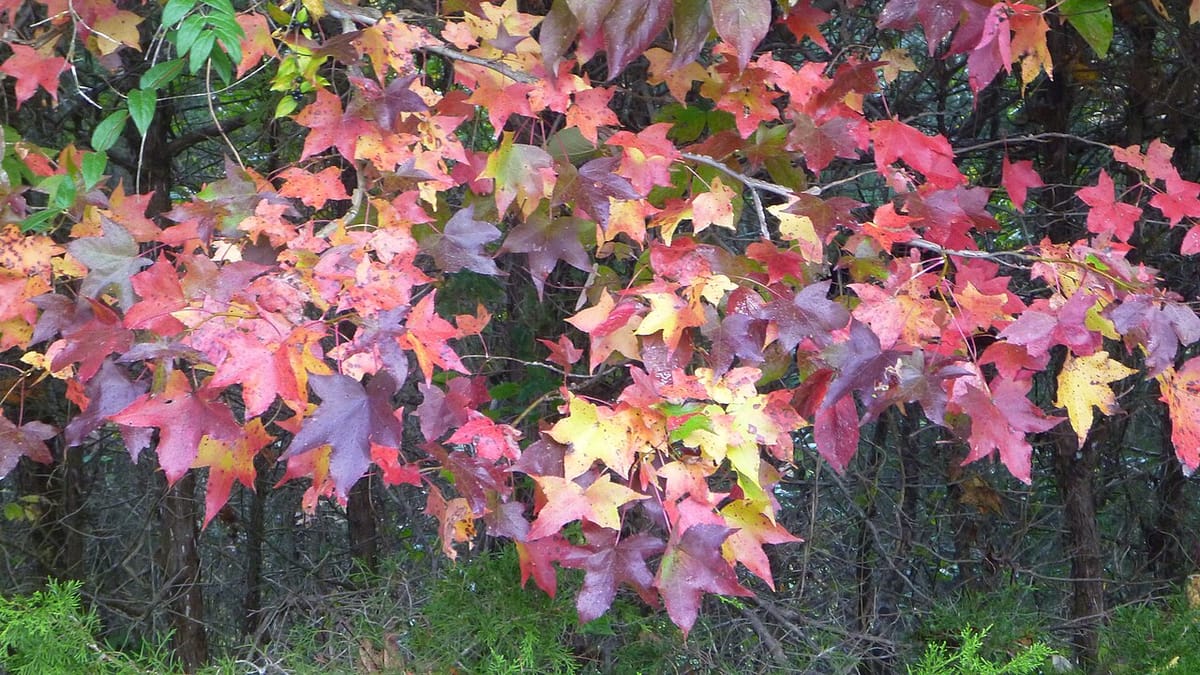
Most people try to identify a fall tree by color alone and get stuck, since half the forest runs some shade of red-orange-yellow. Branching pattern and leaf shape narrow it down in seconds; color just confirms the call.
Start with how the twigs branch
Before you even look at a leaf's shape, look at how it attaches to the twig. Leaves (and the buds and twigs behind them) grow in one of two patterns: opposite, where two leaves sit directly across from each other at the same point on the stem, or alternate, where leaves stagger one at a time, spiraling up the twig. This single check does more identification work than any other single field mark, because opposite branching is rare. Maples, ashes, dogwoods, and viburnums are essentially the whole list of common trees that use it. Everything else defaults to alternate, which includes oaks, birches, aspens, beech, sweetgum, and the vast majority of deciduous trees in a typical northeastern forest.
Find a low branch, look at where two leaves meet the stem, and ask whether they're paired or staggered. If they're paired, you've likely got a maple or an ash and can stop worrying about the other hundred possibilities. If they're staggered, you're in alternate territory and need the next clue: leaf shape.
Maples: the opposite-branching, palmate-lobed standard
Once you know you're looking at opposite branching, maple leaf shape confirms it fast. Maple leaves are palmate: lobes radiate outward from a single central point, the way fingers spread from a palm, usually three to five lobes per leaf. Sugar maple has smooth, rounded notches between broad lobes, the shape on the Canadian flag. Red maple runs smaller and sharper, usually three main lobes with saw-toothed edges. Both turn some mix of scarlet, orange, and gold, sometimes all three colors on one tree, because maples build fresh red pigment in leaves that catch strong sun while yellow shows through wherever sun exposure is weaker. The mechanics behind that split get a full treatment in why some maples turn red and others yellow, and the pigment chemistry behind every species in this guide is covered in leaf pigments explained.
Oaks: alternate branching, lobed leaves that often hang on
Oaks are alternate-branching, and their leaves are pinnately lobed rather than palmate: side lobes branch off a central vein like the barbs of a feather, instead of radiating from one point. White oak group species have rounded lobe tips; red oak group species have lobes that end in a sharp bristle, an easy way to split the genus further once you've confirmed it's an oak at all. Oak fall color tends toward russet, rust, and deep brown rather than the brighter reds of maple, largely because oak leaves carry heavy tannin, a pigment that doesn't fade the way chlorophyll does and ends up as the last color standing once brighter pigments break down or never fully develop.
Oaks are also the most common tree to show marcescence: instead of dropping cleanly in fall, the dead brown leaves stay attached through much of winter, rattling on the branch until spring growth finally pushes them loose. It's most visible on young trees and low branches, and it's a useful backup ID mark on a bare winter walk, long after the color show has ended. The full explanation is in marcescence: why oaks and beeches keep dead leaves all winter.
Aspens and birches: rounded leaves, clean yellow
Quaking aspen and paper birch both run alternate branching with rounded, finely serrated leaves and both finish fall in a clear, uniform yellow with none of the red an oak or maple might mix in. The easiest split between them is the leaf stem. Aspen leaves are nearly circular with a flattened petiole, the small stem connecting leaf to twig, which lets the leaf flutter and quake in the lightest breeze. Birch leaves are more triangular to oval on a rounder stem and don't show that same constant motion. Bark backs up the call: aspen bark stays smooth and pale greenish-white even on mature trees, while paper birch peels in papery curls once it matures, though young birch bark can look closer to aspen at first glance.
American beech: a smooth leaf that also hangs on
Beech breaks the alternate-branching pattern in a useful way: its leaves are simple ovals with straight, evenly spaced side veins, each vein running out to a sharp tooth along the leaf edge, no lobes at all. That smooth, toothed-oval shape is distinctive enough that once you've seen it, you won't confuse it with an oak again. Beech turns a warm copper-bronze in fall, and like oak, young beech and low branches on older trees often hold those dead leaves through winter instead of dropping them, the same marcescence trait covered above.
Ginkgo and sweetgum: two shapes that don't look like anything else
Ginkgo is unmistakable and worth knowing even though it's a planted ornamental rather than a native forest tree: fan-shaped leaves with veins that run outward from the stem in parallel lines rather than branching, no lobes, no teeth. Fall color arrives as a nearly uniform butter yellow across the whole tree, often dropping within a day or two once it starts, which is its own kind of field mark.
Sweetgum leaves are star-shaped, five to seven pointed lobes arranged like a star rather than a maple's rounder palmate shape, and alternate along the twig. What sets sweetgum apart in fall is variety within one tree: purple, red, orange, and yellow leaves can all show up on the same branch at once, since individual leaves vary in how much red pigment they build depending on sun exposure. A maple tends to commit to a color story across most of its crown; a sweetgum often refuses to.
Sumac and Virginia creeper: compound leaves that go first
Not every plant on this list is a single-leaf tree. Staghorn sumac and Virginia creeper both carry compound leaves, meaning what looks like one leaf is actually several leaflets attached to a shared central stalk, and both tend to be among the first plants to color each fall, often weeks before the surrounding maples and oaks commit. Sumac's long, feather-like compound leaves turn a saturated scarlet-orange, usually along roadsides and forest edges where it grows in dense colonies. Virginia creeper, a woodland vine with five leaflets per leaf, does something similar on tree trunks and stone walls, an early streak of red climbing up bark that's still fully green. Neither is a tree in the strict sense, but both are useful calendar markers: if you're seeing bright red edging a field in what still feels like late summer, sumac or Virginia creeper is a more likely source than any tree nearby.
Quick ID checklist
- Check branching first: opposite (maple, ash) or alternate (nearly everything else)
- Palmate lobes radiating from one point: maple
- Pinnately lobed with bristle or rounded tips: oak
- Smooth oval leaf with straight toothed veins: American beech
- Rounded, finely serrated leaf with a flattened, quaking stem: aspen
- Fan-shaped with parallel veins: ginkgo
- Star-shaped, five to seven pointed lobes: sweetgum
- Compound leaflets, early scarlet color: sumac or Virginia creeper
- Dead leaves still attached in winter: likely oak or young beech (marcescence)
Practice on a real hillside
Field marks click faster once you're standing under an actual mixed stand instead of reading about one. Vermont has some of the best sugar maple and paper birch cover anywhere, often growing close enough together that you can compare the palmate maple leaf against the rounded birch leaf on the same short walk. New Hampshire adds a heavier oak and beech component on its lower slopes, useful for practicing the alternate-branching, lobed-versus-toothed-oval distinction once you've got maple down. If you want to see how these species mix by elevation and region before you go, the interactive foliage map tracks color progression and lets you scout a stand's likely species mix ahead of a visit. And if you're curious why the whole color change happens on the schedule it does, why leaves change color covers the trigger behind everything described here.
Frequently asked
- What is the fastest way to identify a tree by its leaves in fall?
- Check the branching pattern first. Opposite branching (twigs and leaves paired directly across from each other) narrows you almost immediately to maples, ashes, and a short list of others. Alternate branching, staggered one at a time, covers most everything else. From there, leaf shape and color tendency usually finish the job.
- How do you tell a maple leaf from an oak leaf?
- Maple leaves have a palmate shape, lobes radiating out from one central point like fingers from a palm, and grow in opposite pairs along the twig. Oak leaves are pinnately lobed, with side lobes branching off a central vein like a feather, and grow alternately, one leaf at a time, staggered along the stem.
- Why do some oak trees keep brown leaves all winter?
- That's marcescence, a trait common in oaks and American beech where the leaf dies and turns brown on schedule in fall but doesn't fully detach. It stays on the branch, often rattling through winter, until new growth pushes it off in spring.
- Are aspen and birch leaves easy to tell apart?
- They're close. Both turn a clear, clean yellow and have rounded, serrated leaves, but quaking aspen leaves are nearly circular with a flattened leaf stem that catches even light wind, which is where the name comes from. Birch leaves run more triangular to oval, with a papery white or gray bark that aspen doesn't have.
- Why does a single sweetgum tree show multiple fall colors at once?
- Sweetgum's star-shaped leaves vary in how much red versus yellow pigment each one builds, often based on how much direct sun that particular leaf or branch gets. The result is purple, red, orange, and yellow leaves all on the same tree, sometimes the same branch, at the same time.
Regions in this article
More in Leaf Science
Leaf Science
Anthocyanins, Carotenoids, and Chlorophyll: Leaf Pigments Explained
Yellow and orange leaves were hiding under the green all summer. Red is different: most trees build that pigment fresh every fall. Here's the chemistry behind both.
2026-07-17 · 4 min read
Leaf Science
Evergreen vs. Deciduous: Why Some Trees Keep Their Leaves
Dropping every leaf each fall looks wasteful, and keeping them through winter looks risky. Both strategies work, and the tradeoff comes down to leaf economics.
2026-07-17 · 4 min read
Leaf Science
How Trees Know It's Autumn: The Science of Shorter Days
Fall color isn't triggered by cold. Trees measure night length with a pigment called phytochrome, then seal off each leaf at the abscission zone.
2026-07-17 · 8 min read