Leaf Science
Marcescence: Why Oaks and Beeches Keep Dead Leaves All Winter
By Benjamin Janes · Published
· 4 min read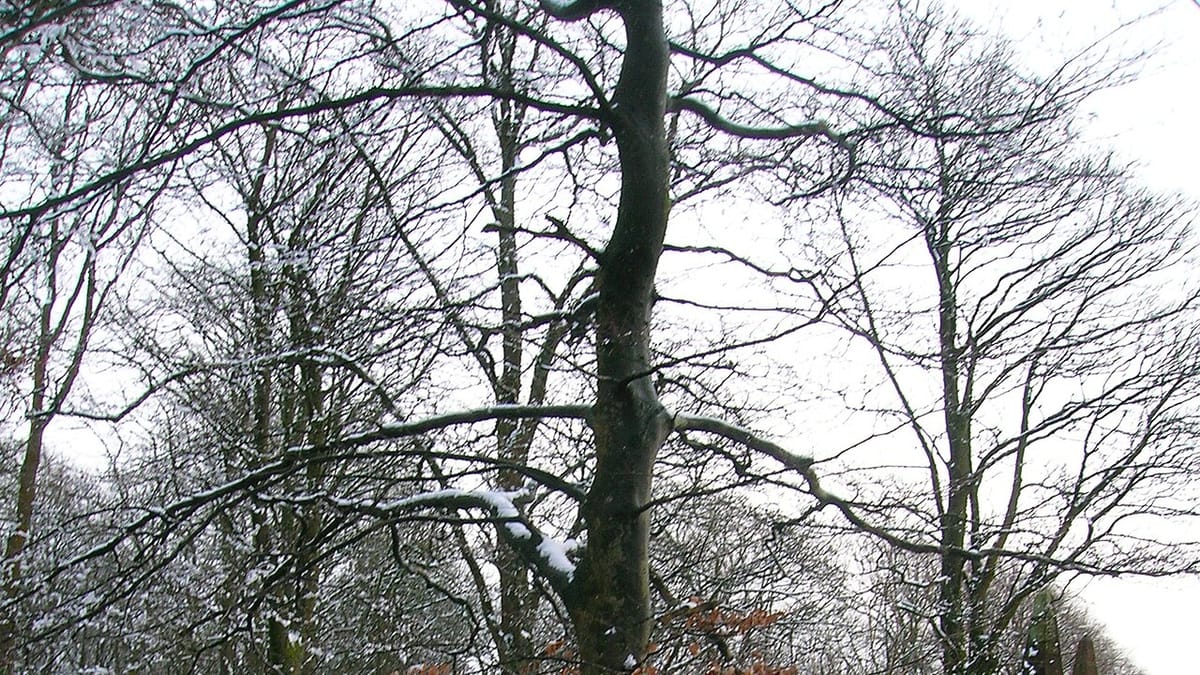
Walk a winter woods and most trees stand bare, but a few hold on to dry, curled leaves that rattle in the wind straight through the cold months. That's marcescence: a delayed leaf drop found mainly in oaks and beeches, and one of the small mysteries left in an otherwise well-understood process.
A holdover, literally
Most deciduous trees finish dropping their leaves within weeks of the fall color change. The abscission layer at the base of each leaf stem builds fully, the connection severs cleanly, and the leaf lets go. In marcescent trees, that layer forms only partway. The leaf dies and turns brown right on schedule, but it stays physically attached, sometimes for the entire winter, until new growth in spring finally pushes it free.
You'll notice it most on young trees and on the lower, inner branches of older ones. A mature white oak might drop leaves normally from its upper crown while the sapling growing in its shade, or the lower branches of the big tree itself, hang on to a full coat of brown leaves into the following spring. That juvenile pattern is one of the clues researchers use when they try to work out why the trait exists at all.
The usual suspects
A handful of oak species (white oak and pin oak among the most reliable) and both American and European beech show marcescence more consistently than almost any other trees in a temperate forest. Some hornbeams and young hickories do it too, in a weaker form. It isn't universal even within a species: two white oaks growing side by side, similar in age and site, can differ in how much of their crown holds leaves through winter.
Picking out a marcescent tree from a distance is easy once you know the tell. The leaves are papery, curled, and tan to copper brown, catching wind in a way bare branches don't, and they cling in patches rather than as a full canopy. That patchiness is itself a clue: a tree holding leaves everywhere, top to bottom, usually means something else is going on, like a young tree that hasn't yet dropped its first full leaf-fall, or in rare cases a stressed or dying limb. True marcescence tends to concentrate low and inside the crown, exactly where a deer's mouth would reach first.
Why keep a dead leaf around
Nobody has nailed down a single confirmed reason, and that's part of what makes the trait interesting rather than a settled textbook fact. A few hypotheses currently lead the field.
One points to deer and other browsing animals. Buds are the tree's most vulnerable investment going into winter, tightly packed with the next year's growth, and a branch wrapped in dry, low-nutrition leaves is a less appealing target than a bare, exposed twig. The rattling itself may add a further deterrent, since dry leaves make noise a browsing animal has to move through.
A second idea treats the leaves as insulation. Retained foliage can blunt drying winter wind and buffer sharp temperature swings around the buds tucked at each leaf's base, which matters most on the low, shaded branches most exposed to browsing height and least protected by the rest of the canopy.
A third looks at timing rather than protection. Leaves that drop in spring, right as the growing season restarts, release their nutrients into the soil close to when new roots and leaves are actively drawing on them, rather than months earlier when the ground is frozen and nothing can use the nitrogen yet. Some researchers see marcescence less as an active strategy and more as an evolutionary holdover, a trait carried by trees whose ancestors grew somewhere the leaf-shedding trigger never fully switched off.
A trait worth watching, not solving
None of these explanations rule out the others, and current research treats marcescence as likely serving more than one purpose depending on the tree, the site, and the local deer population. What's clear is that it's neither a defect nor a sign of stress. The tree isn't struggling to drop its leaves; its abscission layer simply runs on a slower, incomplete schedule in these particular branches, one that resolves itself the moment spring buds start pushing outward.
It's one more reminder that the switch from summer to winter isn't a single clean process repeated identically by every species. The trigger that starts fall (covered in full in how trees know it's autumn) runs the same way across a forest, but what happens after that trigger fires varies by species down to the level of an individual branch.
Where to look for it
Pennsylvania has enough oak-beech forest that a January walk turns up marcescent stands without much searching, especially on the lower slopes where young beech tends to fill in under an older oak canopy. In Germany, European beech does the same thing across huge stretches of managed forest, and older beech hedgerows planted specifically for the trait keep their copper-brown leaves as a winter windbreak long after the rest of the hedge line has gone bare. If bare winter branches feel like the end of the foliage season to you, marcescent trees are proof there's still texture out there once the maples and birches have let go. For how the opposite strategy works (needled trees that skip the seasonal leaf drop question altogether), see evergreen vs. deciduous, and for more stops worth a cold-weather walk, browse the interactive map.
Frequently asked
- What is marcescence?
- Marcescence is when a tree's dead, dried leaves stay attached through winter instead of falling in autumn like the rest of the forest. The leaves are fully brown and no longer functioning; the tree simply hasn't finished cutting them loose. New spring growth eventually pushes them off.
- Why do oak trees keep their dead leaves in winter?
- Botanists haven't settled on one answer. Leading ideas include the leaves discouraging deer from browsing on buds, insulating next year's buds against cold and drying wind, or timing nutrient release from fallen leaves closer to spring, when new growth can use it. It may be some mix of all three.
- Do all oaks and beeches show marcescence?
- No. It's strongest in young trees and on the lower, inner branches of certain species, particularly white oaks, pin oaks, and American and European beech. Mature trees and upper branches on the same species usually drop leaves normally in fall, so the pattern within one tree is often uneven.
- Is marcescence harmful to the tree?
- No. It's a normal, if unusual, variation on the typical process of dropping leaves for winter. The tree isn't sick and the leaves aren't struggling to fall; the abscission layer at each leaf's base simply forms more slowly than usual, on a schedule that finishes the following spring instead of the previous fall.
Regions in this article
More in Leaf Science
Leaf Science
Anthocyanins, Carotenoids, and Chlorophyll: Leaf Pigments Explained
Yellow and orange leaves were hiding under the green all summer. Red is different: most trees build that pigment fresh every fall. Here's the chemistry behind both.
2026-07-17 · 4 min read
Leaf Science
Evergreen vs. Deciduous: Why Some Trees Keep Their Leaves
Dropping every leaf each fall looks wasteful, and keeping them through winter looks risky. Both strategies work, and the tradeoff comes down to leaf economics.
2026-07-17 · 4 min read
Leaf Science
How to Identify Trees by Their Fall Leaves
A field method for naming trees by autumn leaves: check the branching pattern first, then leaf shape, then color, and most common species sort themselves out fast.
2026-07-18 · 6 min read