Holidays & Celebrations
Diwali: Why the Festival of Lights Falls in Autumn
By Benjamin Janes · Published
· 4 min read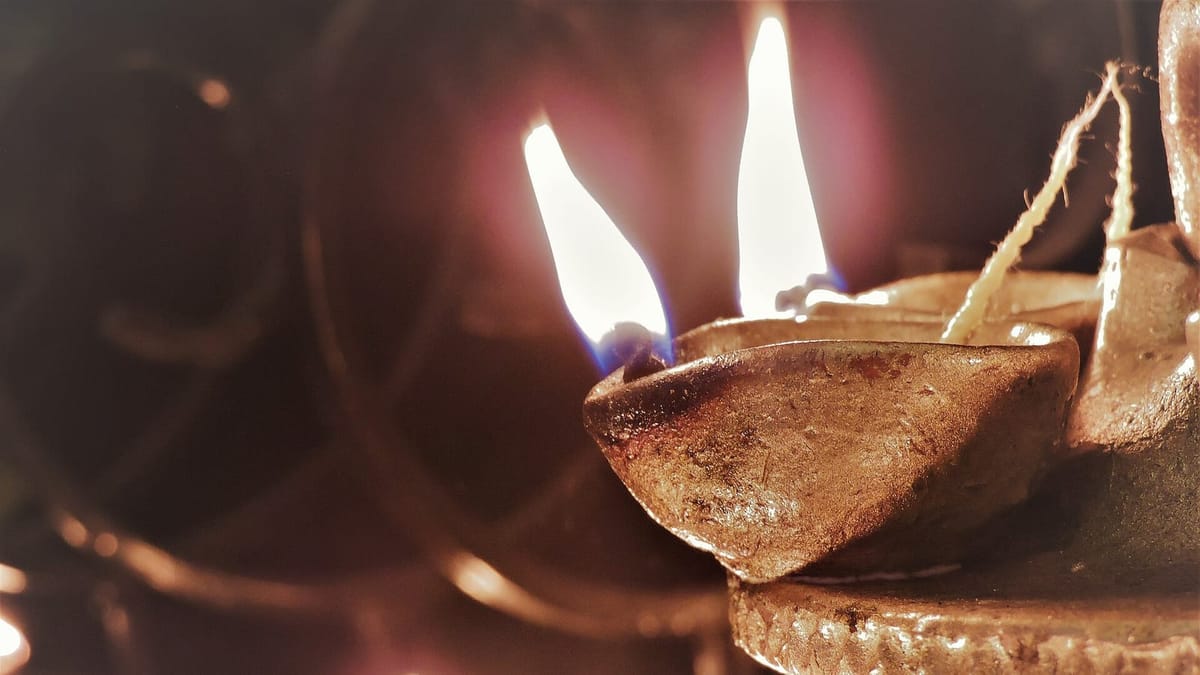
Diwali lights oil lamps across every home that celebrates it, on purpose, during the darkest night of its lunar month, timed to the new moon that falls in the Hindu month of Kartik. That timing is the whole point: the festival of lights is built to answer the year's least-lit night, which is why it lands in autumn rather than on any fixed Western date.
A festival built to answer the darkest night
Diwali's name comes from the Sanskrit "deepavali," meaning a row of lighted lamps, and that name is literal instructions, not metaphor. Small clay oil lamps called diyas line windowsills, doorways, and rooftops on the holiday's main night, chosen specifically because that night is the new moon, the one point in the lunar month with no moonlight at all to help. Rangoli patterns get drawn at thresholds in colored powder or flower petals, and in much of the world today, fireworks fill in for what lamps alone used to handle. None of it is decorative in the way string lights on a porch are decorative. The whole point of Diwali is to put light exactly where the calendar has taken it away.
Why a Hindu festival keys off the moon
Diwali follows the lunar Hindu calendar rather than the solar Gregorian one most of the world schedules by, which is why it doesn't sit on a fixed Western date. The holiday centers on the new moon that falls in the month of Kartik, and because a lunar month doesn't divide evenly into a solar year, that new moon drifts against the Western calendar from one year to the next, landing anywhere from the middle of October to the middle of November depending on the year. The holiday isn't unusual in this regard: several of the season's biggest festivals run on lunar calendars of their own, each drifting against the Western calendar in its own way, which is part of why autumn's holiday calendar never repeats itself exactly from year to year.
More than one religion, the same lunar week
Diwali is often described as a Hindu festival, and it is one, but it isn't only one. Jains mark the same days as the anniversary of Mahavira's spiritual liberation, the moment their tradition holds he achieved final release from the cycle of rebirth. Sikhs observe Bandi Chhor Divas over the same week, commemorating the release of Guru Hargobind from imprisonment and his insistence on freeing dozens of other political prisoners alongside him. Newar Buddhist communities in Nepal observe their own version as well. Four distinct religious traditions, each with its own story and its own reason for the date, converge on the same handful of nights, more a shared calendar window than a single unified holiday.
Five days, several different stories
In much of North India, Diwali is understood as five connected days rather than one. Dhanteras opens the stretch, associated with wealth and prosperity and traditionally a day for buying gold or new household items. Naraka Chaturdashi, sometimes called Choti Diwali, follows, commemorating a victory over a demon named Narakasura. The main night centers on Lakshmi Puja, welcoming the goddess of prosperity into a freshly cleaned home, and in North India that same night is tied to the Ramayana: Rama's return to Ayodhya after his exile and his defeat of Ravana, with lamps lit along the roads specifically to guide him home in the dark. Govardhan Puja follows, honoring a story about Krishna, and the stretch closes with Bhai Dooj, a day set aside to celebrate the bond between siblings. South India tends to emphasize a different story altogether, centering Krishna's own defeat of Narakasura rather than Rama's homecoming, a reminder that Diwali was never one script performed the same way everywhere.
A harvest festival wearing a mythology's clothes
Underneath the gods and demons, Diwali also does the same job any autumn harvest festival does. The holiday falls after the monsoon harvest across much of India, and for many trading and merchant communities it doubles as the start of a new financial year, with Lakshmi Puja extending to a ritual blessing of account books called Chopda Pujan. Businesses close out old ledgers and open new ones on the same night the household lights its diyas, treating prosperity for the year ahead as something worth asking for formally rather than assuming. That layering of harvest gratitude, new-year housekeeping, and mythology is exactly the kind of stacking the season produces everywhere it goes, the same instinct that built a harvest holiday into a religious one on the other side of the world too.
Where the lamps meet the foliage
Himachal & Uttarakhand sees Diwali arrive at almost the same time its own hillsides are turning, oil lamps glowing on the same evenings the surrounding slopes carry their own color. Nepal keeps a closely related five-day festival of its own called Tihar, observed across Nepal Himalaya by Hindu and Newar Buddhist communities alike, with its own version of the lamps, its own household rituals, and its own overlap with the region's mountain autumn. Marigolds show up constantly in both places, strung into garlands for doorways and offerings, the same flower that does similar work an ocean away at Día de los Muertos altars, though neither tradition borrowed the idea from the other.
For the rest of the season's festivals of light, harvest, and remembrance, the autumn holidays hub sets Diwali alongside its counterparts around the world, and the interactive foliage map tracks color across the Himalayan regions mentioned here in close to real time.
Frequently asked
- Why does Diwali fall in autumn instead of a fixed date?
- Diwali follows the lunar Hindu calendar, centered on the new moon in the month of Kartik, which typically falls in the autumn stretch of the Western calendar. Because lunar and solar calendars don't align evenly, the exact date shifts by weeks from year to year rather than landing on a fixed day.
- Is Diwali only a Hindu holiday?
- No. Jains mark the same days as the anniversary of Mahavira's spiritual liberation, Sikhs observe Bandi Chhor Divas over the same week, and Newar Buddhist communities in Nepal keep their own related observance. Several traditions converge on the same lunar window, each with a distinct story behind it.
- How many days does Diwali last?
- Traditionally five, each with its own focus: Dhanteras for prosperity, Naraka Chaturdashi, the main night centered on Lakshmi Puja, Govardhan Puja, and Bhai Dooj honoring siblings. Regional practice varies, and South India often emphasizes different stories than the North Indian sequence.
- What does Diwali have to do with the harvest?
- Diwali falls after the monsoon harvest across much of India, and for many merchant communities it also marks the start of a new financial year, with rituals blessing account books alongside the household's lamps. The festival layers harvest gratitude underneath its better-known mythology.
Regions in this article
More in Holidays & Celebrations
Holidays & Celebrations
Autumn Holidays Around the World: Harvest, Light, and Remembrance
A tour of the world's autumn holidays and the three things nearly all of them share: bringing in the harvest, lighting up the dark, and remembering the dead.
2026-07-17 · 7 min read
Holidays & Celebrations
Día de los Muertos: Marigolds, Ofrendas, and Remembering Well
Día de los Muertos explained: how Indigenous ancestor veneration and the Catholic calendar combined into a joyful, marigold-scented holiday of remembrance.
2026-07-17 · 4 min read
Holidays & Celebrations
From Samhain to Trick-or-Treat: The Real History of Halloween
Halloween's roots run through the Gaelic fire festival Samhain, the Christian All Hallows' Eve, and the nineteenth-century Irish immigration that carried it to America.
2026-07-17 · 4 min read