Traditions Around the World
Momijigari: Japan's Thousand-Year Art of Leaf Hunting
By Benjamin Janes · Published
· 7 min read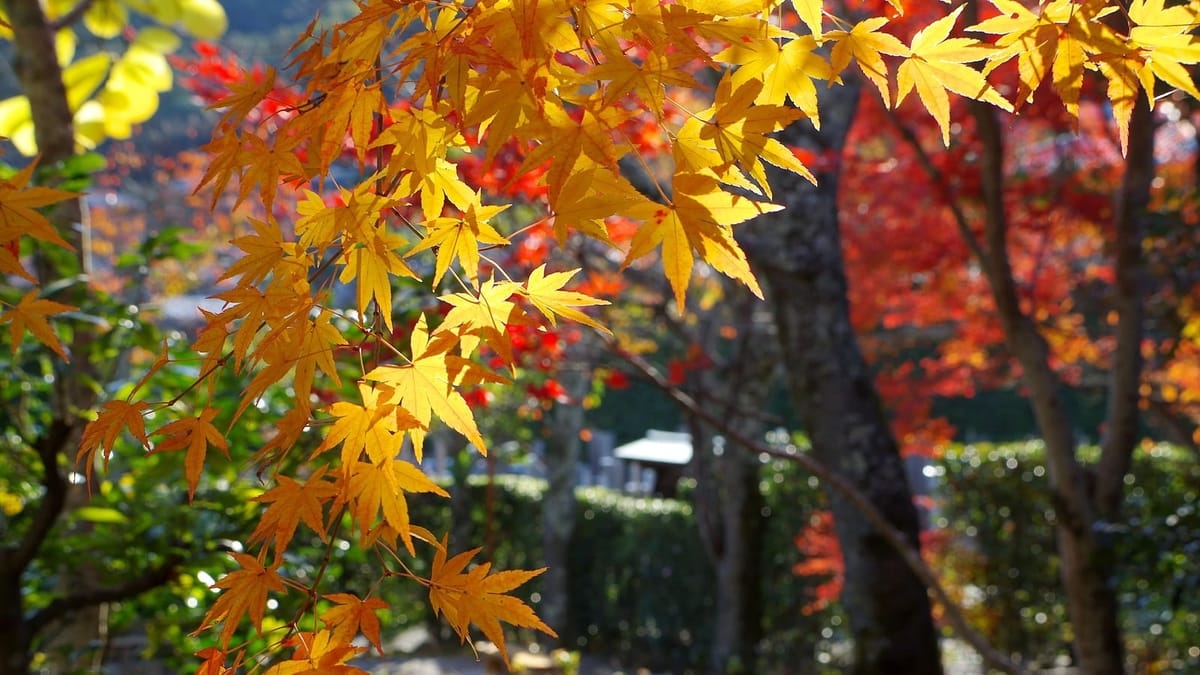
Momijigari means "leaf hunting," and Japan has been doing it on purpose since the Heian court. It isn't a hike, and it isn't quite a holiday either. It's a centuries-old habit of walking out to stand under maples on fire with color, and it still shapes how millions of people spend a few weeks each fall.
A word built like a hunting trip
Break the word down and it gets stranger, not simpler. Momiji is the maple, or more broadly the turning leaf itself. Kari is hunting, the same character used for chasing game or hawking. Nobody in Kyoto is bagging leaves and hauling them home in a sack, though pressing a few between the pages of a book is common enough. The word survives from an era when travel of any kind, even a short trip to look at a hillside, got framed as an expedition. You didn't simply see the maples. You went out and hunted them, the way you might hunt mushrooms or hunt for a good fishing spot.
That framing tells you something the modern English phrase "leaf peeping" doesn't. This was never a passive activity. Going to look at leaves has always implied a plan, a destination, and some effort.
Poems instead of trophies
The custom first shows up among Heian-period aristocrats, roughly the eighth through twelfth centuries, who built an entire poetic vocabulary around watching the seasons turn. Cherry blossoms got the spring version of this treatment. Hanami is the direct cousin of momijigari: same impulse, different tree, different mood. Where hanami poems lean into fleeting beauty gone within days, autumn maple poems tend toward a slower kind of sorrow, color as a preview of the bare branches to come. Court poets wrote waka about maple leaves adrift on temple ponds, about a single branch carried home as a kind of souvenir, about the particular ache of watching something get more beautiful right before it disappears.
None of this stayed confined to the aristocracy for long. By the time ordinary travel opened up to merchants and pilgrims centuries later, leaf viewing had already spread well past the palace grounds and into temple gardens built, at least in part, with this exact audience in mind.
The color front rolls south and downhill
Japan runs nearly two thousand kilometers north to south, and its autumn color follows that geography on a schedule you can actually track. The turn starts in Hokkaidō in the north, where the season's first maples and larches go early. From there it works down through the mountains, including the high passes of the Japanese Alps — Chūbu, before it finally reaches the old capital region of Kansai — Kyōto & Nara, home to Kyoto and Nara, weeks after Hokkaido has already gone bare.
That lag is the whole reason momijigari became a travel-worthy pursuit instead of a single weekend on the calendar. A family with the means to travel could, in principle, chase the color the length of the country, starting in the northern hills and ending in a Kyoto garden a month or more later. Most people don't go to that trouble, but the fact that they could is baked into how the season gets talked about here: not as a date, but as a moving front.
Kyoto's gardens were built for this
No city takes momijigari more seriously than Kyoto, and the seriousness predates tourism by centuries. Temples across the city planted and pruned their maple groves with viewing in mind, the same way a rose garden gets planted for a certain kind of visitor. Tofuku-ji, Eikan-do, the Arashiyama district along the Oi River all work this way. Walk through Kyoto in the back half of autumn and you'll see the results: maples framed against a pond so the color doubles in the reflection, a single tree left standing at the exact bend in a path where visitors are meant to stop and look up.
Some temples extend their viewing hours after dark and light the maples from below, a custom called raito appu, illuminated viewing, that turns a quiet garden into something closer to a lantern show. It draws a crowd, and it's also genuinely worth the wait once, if you're there at the right point in the season.
Momiji off the tree
The custom shows up well beyond garden paths. In Minoh, a town in the hills north of Osaka and squarely inside Kansai, vendors have battered and deep-fried maple leaves into a crunchy, faintly sweet snack for generations, odd enough to surprise most first-time visitors and beloved enough that nobody local questions it. Elsewhere in Japan, confectioners shape maple-leaf sweets from bean paste and sell them by the box as a seasonal gift, the way boxed chocolates get sold around a Western holiday. None of it reads as novelty merchandise the way a souvenir T-shirt would. It's closer to how a New England bakery leans on apples and cinnamon come fall, an entire regional food culture built around the calendar.
Even the color itself gets treated as raw material. Dried maple leaves turn up pressed into stationery, folded into origami, printed onto everything from train tickets to seasonal packaging at convenience stores that otherwise sell nothing remotely sentimental. A country that spent a thousand years writing poetry about these leaves has had plenty of time to find new ways to keep them around after they fall.
Reading the forecast, then and now
The Heian court had no satellite data, but they were tracking the season closely enough to know roughly when to expect it, the way farmers still read a landscape without a thermometer. That instinct now has a modern, almost bureaucratic form: the momiji zensen, or autumn leaf front, a set of maps updated weekly through the season by Japan's weather services and several private forecasters, tracking projected peak color prefecture by prefecture. It gets treated with roughly the same seriousness as the spring cherry blossom forecast, which says plenty about how central this custom still is to daily life.
November 20–December 10 in a typical year gives you a modern version of that same read for the capital, and it's worth checking separately from a Kyoto trip rather than assuming the two cities move together. Tokyo and Kyoto sit close enough on a map that visitors often expect a shared calendar. They don't quite have one; elevation and microclimate nudge the two out of sync in most years. Our own interactive foliage map tracks that same kind of shifting front for regions well outside Japan, if you want to see the general idea applied somewhere closer to home.
Going without becoming the story
A crowded temple garden is still a temple garden, and the etiquette that applies on any other day doesn't get suspended just because everyone showed up for the maples. Stay on the paths. Don't break off a branch for a photo; thousands of other visitors want to see that same tree intact next week. Keep your voice down inside temple precincts even when the crowd around you isn't. None of this is exotic advice. It's the courtesy you'd extend at any place of worship, applied to a season that tends to make people forget themselves a little.
Momijigari etiquette
- Stay on marked garden paths, even when they're crowded
- Never snap a branch or pick leaves for a photo
- Keep your voice down inside temple precincts
- Visit within the first hour after opening, or on a weekday
- Check a same-day forecast rather than assuming Tokyo and Kyoto share a calendar
If you're planning a trip specifically around this, our Japan destinations guide rounds up the regions and cities where the color shows up most reliably, from the northern hills down through Kansai.
A tradition Japan shares, in its own key
Japan didn't invent the idea of building a season around watching the natural world change, and momijigari isn't as isolated a custom as it might look from the outside. Cultures across the temperate world have spent centuries doing some version of the same thing, with a different focus and a different calendar each time. Europe built its own autumn around the wine and cattle harvest rather than the maples, a tradition covered in our look at Alpine and European autumn customs. Korea's Chuseok, detailed in our guide to Korea's autumn thanksgiving, centers the same season on ancestors and a shared meal rather than a garden walk. Britain kept a louder, stranger version of the season alive, covered in our piece on bonfire night and Britain's autumn rituals, and the whole idea of a formal harvest celebration has a long shared history across Western harvest festivals that goes back further than most people assume.
What momijigari offers that a lot of these other customs don't is a genuinely portable practice: not a single feast day, but weeks of moving color you can plan an entire trip around, using forecasts that get more precise every year. The Heian poets who started writing verse about maple leaves over a thousand years ago couldn't have imagined a weather map for the color front. They would have understood the impulse behind checking one, completely.
Frequently asked
- What does momijigari mean?
- Momijigari means leaf hunting: momiji for the maple or turning leaf, kari for hunting or chasing game. The word dates to the Heian court, when viewing autumn color, like viewing cherry blossoms in spring, was treated as a deliberate outing rather than something you simply noticed on a walk.
- When is the best time to see momijigari in Japan?
- There's no single window, since color moves the length of the country over roughly two months, starting in the northern hills and reaching Kyoto and the Kansai region much later. Japan's weather services publish weekly momiji zensen forecast maps through the season, the same style of tracking used for the spring cherry blossom front.
- Is momijigari the same as hanami?
- They're siblings, not the same custom. Hanami is spring cherry blossom viewing; momijigari is its autumn counterpart, built around maples rather than cherry trees. Both trace back to Heian court poetry about the changing seasons, though momijigari verse tends toward a slower, more reflective mood than hanami's fleeting-beauty theme.
- Where in Japan is momijigari most popular?
- Kyoto's temple gardens, including Tofuku-ji, Eikan-do, and the Arashiyama district, are the custom's best-known stage, planted and maintained with maple viewing in mind for centuries. Color reaches Kansai later than Japan's north, so Kyoto's peak typically falls well after Hokkaido's has already finished.
- What's the etiquette for visiting Japan's maple gardens?
- Stay on marked paths, never break off branches for photos, and keep noise down inside temple precincts, the same courtesy expected on any other day. Visiting within the first hour after opening, or on a weekday, is the most reliable way to see the gardens without the heaviest crowds that build later on.
Regions in this article
More in Traditions Around the World
Traditions Around the World
Bonfire Night and Conkers: Britain's Autumn Rituals
From playground conker matches to fire festivals and the fifth of November, how Britain marks the end of the harvest and the start of the dark months.
2026-07-17 · 4 min read
Traditions Around the World
Chuseok: Korea's Autumn Thanksgiving
Chuseok is Korea's biggest holiday: ancestral rites, half-moon rice cakes, and a nationwide trip home timed to the harvest moon.
2026-07-17 · 4 min read
Traditions Around the World
Harvest Festivals Through History: From Lammas to the County Fair
How England's Lammas bread and corn dollies evolved into Harvest Home suppers and, eventually, the modern American county fair.
2026-07-17 · 4 min read