2026 Fall Foliage Forecast: When Leaves Peak in Every State
By Benjamin Janes · Published
· 6 min read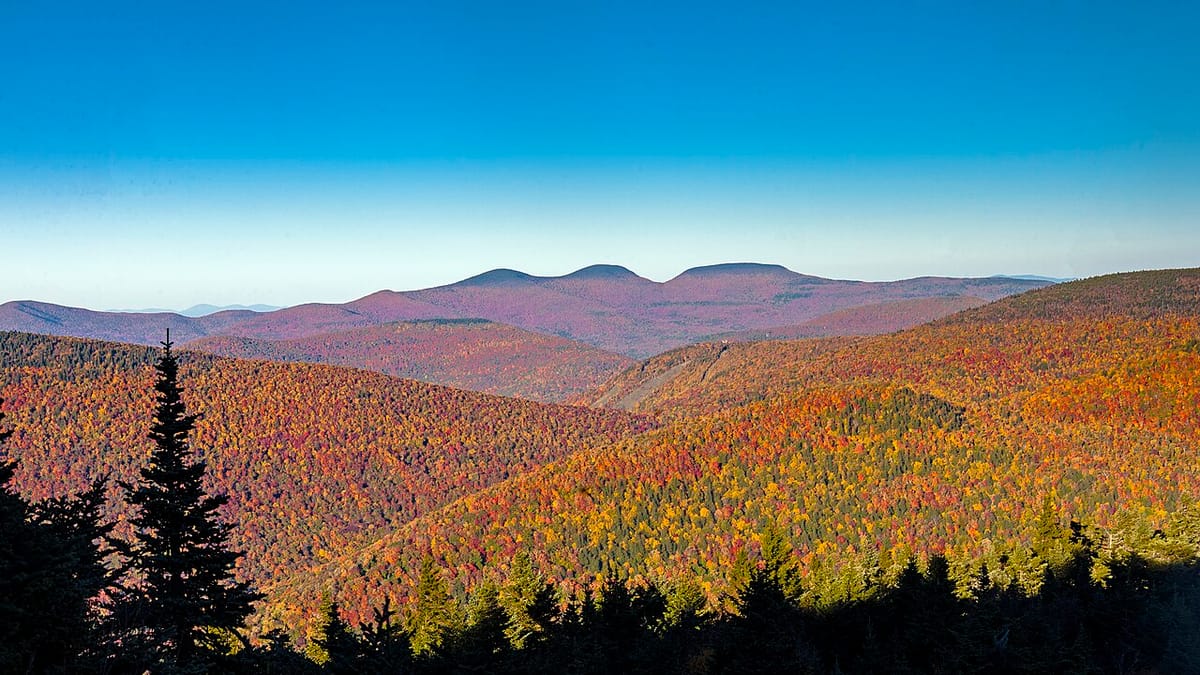
This is our 2026 fall foliage forecast for the United States and Canada: where the season starts, how it moves, and the live model behind every window below. Alaska and the northern Rockies trigger first; the Southeast and the Pacific Coast hold color longest. The interactive map updates every window here as real weather comes in.
How this forecast is made
Every region below gets its window from the same model that colors the live map. Daily temperatures come from the ERA5 weather reanalysis, a gridded historical and forecast record pulled through Open-Meteo, and those temperatures drive a phenology model: night length sets the season's rough floor, then accumulated autumn cooling determines how fast color actually builds on top of it. Roughly 30-meter terrain data shifts that timing locally, since a slope turns about a day earlier for every 300 meters it climbs (the same elevation effect that puts a mountain corridor deep in color while a valley town an hour away is still green). Each region is also calibrated against real published peak dates, because temperature alone cannot tell a maritime autumn in the Pacific Northwest from a continental one in Minnesota. Held-out testing puts the model within about five days of the real peak on average, tighter in flat interior regions and wider in mountains and coastlines.
Forecasts made this far ahead lean on recent-year climate normals rather than a specific incoming cold snap, so treat every window below as a planning estimate, not a locked date. The live map is the fastest way to watch a region's date range sharpen as fall gets closer.
New England
New England is the region most people mean when they say "leaf peeping," and it earns the reputation on sugar maple alone: the same tree that makes syrup turns some of the most saturated reds and oranges anywhere in the world. October 7–October 11, 2026 (forecast) and October 12–October 16, 2026 (forecast) both follow the classic ridge-to-valley pattern, color starting high on the Green Mountains and the White Mountains' Presidential Range before working down into river towns like Woodstock and North Conway. October 10–October 14, 2026 (forecast) tends to trail Vermont by a few days near the coast, though inland Baxter State Park often turns with the mountains further west. Expect the fastest-moving color in this whole forecast: a weekend that catches one valley at peak can miss the next one entirely.
Mid-Atlantic & Appalachians
South of New England, the palette shifts from maple-heavy toward mixed oak, hickory, and tulip poplar, a mix that tends to hold its color longer but peak less uniformly. October 9–October 18, 2026 (forecast) covers the Poconos and the Allegheny Plateau, both running close behind New England on the calendar. October 14–October 30, 2026 (forecast) anchors the Blue Ridge Parkway and Shenandoah National Park, where color rolls south along the ridgeline over several weeks instead of arriving all at once. West Virginia's high Alleghenies often turn first in this group, since so much of the state sits well above the valleys around it.
Southeast
The Southeast's display is more compressed and more elevation-dependent than anywhere else on this list, since the same mild winters that keep the Piedmont green push the turn later than most visitors expect. November 8–November 14, 2026 (forecast) centers on the Blue Ridge and the Great Smoky Mountains, where color starts at altitude near Clingmans Dome and takes several weeks to work down into the lower coves. October 31–November 5, 2026 (forecast) tracks closely with it on the Smokies' other flank. Further south and lower in elevation, Georgia holds on to green the longest of this group, with the mountains around Blue Ridge and Helen turning well before Atlanta's own street trees catch up.
Midwest & Great Lakes
Sugar maple and aspen move fast once they start, which is why the Midwest's season feels shorter and more urgent than the Southeast's long fade. October 7–October 11, 2026 (forecast) covers both the Upper Peninsula, which usually leads the whole region, and the Lower Peninsula's Tunnel of Trees corridor along Lake Michigan. October 5–October 11, 2026 (forecast) follows a similar north-to-south pattern through the Northwoods and down toward Madison. Minnesota, pushed early by its northern latitude, often turns before either of its neighbors.
Plains & Rockies
West of the Mississippi, elevation does more of the work than latitude, and nowhere is that clearer than the Rockies' aspen groves, which turn a solid gold rather than the mixed red, orange, and yellow of an eastern hardwood forest. October 1–October 18, 2026 (forecast) tracks high country like Rocky Mountain National Park and the San Juan Mountains well ahead of Denver's own street trees. October 4–October 13, 2026 (forecast) follows a similar pattern around Grand Teton and the Bighorns. Out on the plains themselves, color is thinner and later, mostly cottonwoods along river bottoms rather than a canopy-wide display.
Southwest
Foliage in the Southwest is a high-elevation specialty rather than a statewide event, tucked into aspen groves well above the desert floor most people picture when they hear "New Mexico" or "Arizona." October 15–October 27, 2026 (forecast) centers on the Sangre de Cristo Mountains above Santa Fe and Taos, where aspen color reads dramatic against dark conifer forest. October 19–November 19, 2026 (forecast) follows the same logic around the San Francisco Peaks and the White Mountains, both a real temperature drop above Phoenix. Neither state's lowlands see much of a display at all.
Pacific
The Pacific states run later and hold color longer than almost anywhere else in this forecast, since a mild, wet climate slows the same chemistry that a harder frost speeds up further east. October 15–November 2, 2026 (forecast) and October 4–October 29, 2026 (forecast) both lean on big-leaf maple and vine maple in the lowlands, with larch turning gold at higher elevations in the Cascades. California is its own case: aspen and cottonwood color the Eastern Sierra around Bishop and June Lake earlier in the season, while valley oaks and the state's wine country hold on much longer.
Alaska
Alaska runs its own calendar, weeks ahead of everywhere else on this list, since far northern latitude means the night-length trigger that starts the whole season fires earliest here. August 28–September 8, 2026 (forecast) covers birch and aspen color across the Interior and the Kenai Peninsula, both usually done turning while the Lower 48 is just getting started. It's a short, fast season: birch can go from green to bare in a couple of weeks once the trigger fires.
Canada
Canada's three major foliage regions each have their own character. October 4–October 8, 2026 (forecast) centers on Algonquin Park's sugar maple and yellow birch, among the most photographed color in the country. September 4–September 24, 2026 (forecast) covers the Laurentians and the Eastern Townships, where the same maple palette meets a longer, more rural drive circuit. And Nova Scotia, reached along the Cabot Trail, runs a coastal season shaped by the Atlantic, the way New England's own coast runs cooler than its inland mountains.
Plan your trip around the forecast
A regional window like the ones above is the right tool for picking where and roughly when to go. The live map is the right tool for narrowing that window once your travel dates are close and the model has real weather to work with instead of a normal-year estimate.
To understand what "peak" is actually measuring before you lock in dates, what is peak foliage covers the definition directly, and how fall foliage forecasts work goes deeper into the model behind every window on this page. For turning any of these regions into an actual itinerary, our 2026 road trip guide covers five specific routes, including Vermont's Route 100 and Virginia's stretch of the Blue Ridge Parkway, and our New England hiking guide pairs well with the New England window above if you'd rather earn the view on foot.
Frequently asked
- How far in advance can a 2026 fall foliage forecast actually be trusted?
- The season's rough shape is reliable months out, since it's set by night length, which is fixed for any given latitude. The weather layered on top of that trigger is what determines a specific window, and that part sharpens considerably in the final couple of weeks before a trip.
- Which region peaks first, and which peaks last?
- Latitude sets the general order: Alaska and Canada's northern regions trigger earliest, followed by New England and the northern Rockies, while the Southeast and the Pacific Coast hold their color longest. Elevation complicates that order locally, since a high ridge in a southern state can turn before a low valley much further north.
- Does this forecast include Canada, or just the US?
- Both. The same model and the same live map cover Ontario, Quebec, and Atlantic Canada alongside every US region, using the same weather data and the same phenology approach on both sides of the border.
- How is a model-based forecast different from a state tourism board's foliage report?
- A tourism board's report is usually a person's visual read on current conditions in one area, updated on their own schedule. This forecast is a weather-driven model covering the whole map at once, which makes it useful earlier in the planning process, though a local report close to your trip is still worth checking for the specific spot you're headed to.
- Will these forecast windows change between now and fall?
- Yes, and that's by design. Early windows lean on recent-year climate normals, and as summer turns to fall the model swaps in real observed weather, which is why the same region's window can shift by several days as your trip gets closer.