When do the leaves change in Munich?
Munich's autumn is beer-tent season, but it is also golden chestnuts, limes, and beeches along the Isar and across the vast Englischer Garten. City color is genuinely satisfying, and the Bavarian Alps an hour south add larch gold and early snow for one of Europe's better fall pairings.
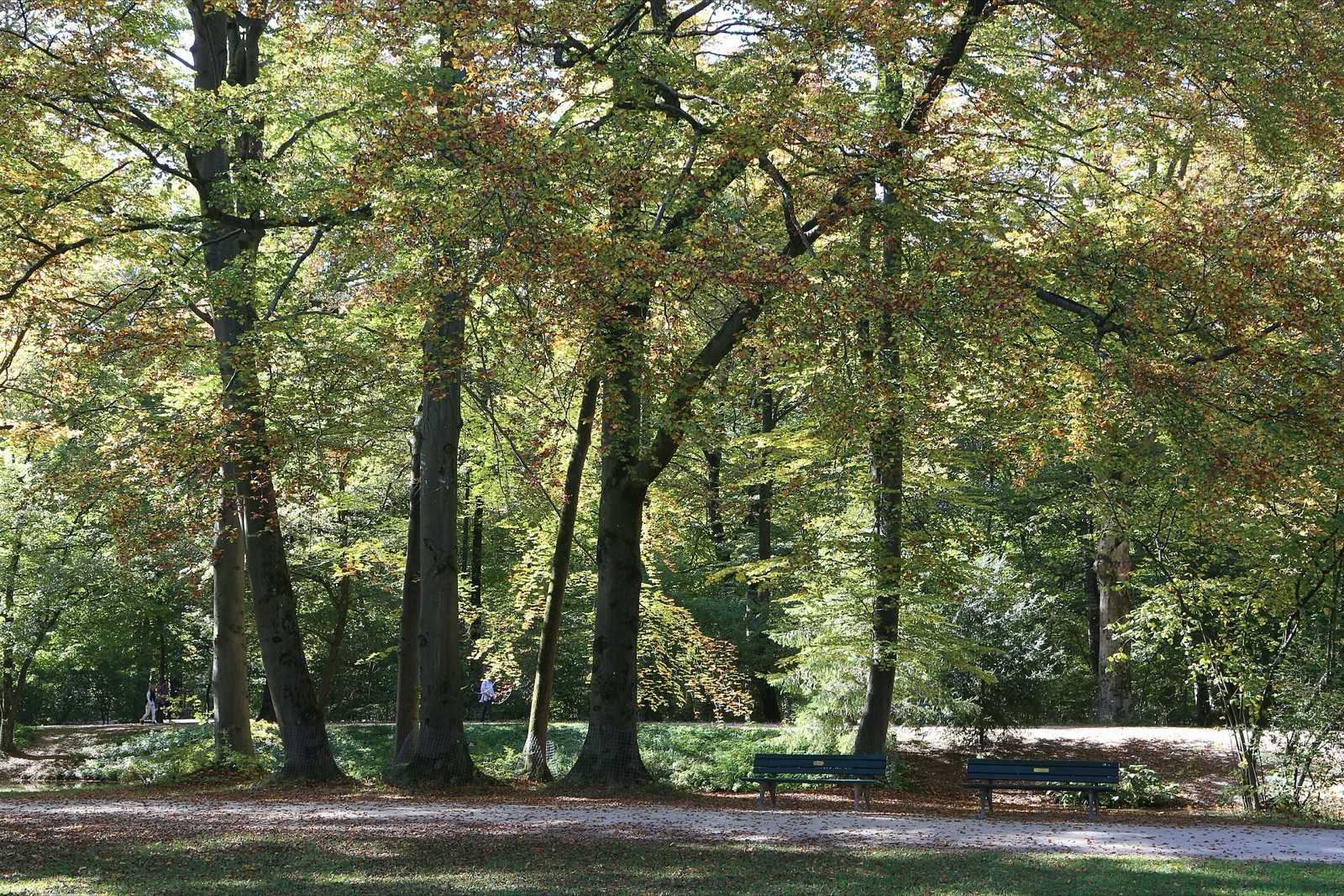
Peak: October 3–October 12
Color builds from September 26 · mostly bare by October 26
Sampled at Munich’s own coordinates rather than a regional average. Dates are computed for Munich itself at 521 m elevation. Street trees vary block to block, so check locally before you plan a weekend around it.
This window comes from 84 weather points across Germany, checked against 4 published peak dates from germany.travel. This year's weather has the peak running 1 day earlier than a normal year. Peak dates spread about 10 days inside Germany, so the high ground turns well before the valleys. How the forecast works
Fall activities in Munich
Drag the date slider to see when color moves through the country around Munich, or tap a pin for that stop’s own peak window.
Viewpoint
Peak September 25
Ludwig II's fairy-tale castle above Hohenschwangau turns its beech-and-maple hillside gold each October, best seen from the Marienbrücke…
in Germany
Where locals go
Englischer Garten
City parkPeak October 8
One of the world's largest urban parks, bigger than Central Park, turns amber through its plane-tree avenues and the meadows around the…
Munich in Autumn: Beer Gardens, the Englischer Garten, and the Alps
Munich's autumn is a two-act season: golden weeks in the city, when beer gardens hold out under turning chestnuts and the Englischer Garten goes bronze, and a string of Alpine day trips an hour south, where larches light up above dark lake water. This guide covers both, plus where locals actually spend their October weekends.
The Englischer Garten at full scale
The Englischer Garten is one of the largest city parks in Europe, bigger than Central Park, and its two halves age through the season differently. The southern half is the postcard: the Monopteros temple on its hill, the standing wave at the Eisbach where surfers in thick wetsuits keep riding deep into the cold months, the Chinesischer Turm with its pagoda and brass bands. Its maples and horse chestnuts turn first, and on a sunny October Sunday the lawns fill with half the city.
The northern half, the Hirschau beyond the Kleinhesseloher See, is where you go once you've seen the postcard. Past the lake the park loosens into floodplain woodland, long gravel paths under old beeches and ash, with sheep grazing in the meadows and a fraction of the foot traffic. Walk it end to end and the park stops feeling like a park and starts feeling like a countryside walk that happens to begin downtown. For the classic view, climb the Monopteros in the last hour of light: the Frauenkirche's domed towers rise out of a bronze canopy, and the crowd on the hill is part of the ritual rather than an obstacle to it.
Beer-garden season's long goodbye
Munich's beer gardens exist because of trees. Brewers once stored beer in cellars along the Isar's high bank and planted horse chestnuts overhead for dense summer shade; the tables came later, and the trees stayed. Chestnuts are among the first big trees to turn, which means the beer gardens get their color early, right as the season that built them winds down.
After the Wiesn wraps up in early October the city audibly exhales, and locals take the gardens back. The rules are worth knowing: tables with tablecloths are for table service, bare tables are self-service, and at self-service tables you may bring your own food, a tradition people use seriously, spreading out radishes, pretzels, and cheese from home. You buy the beer, always. Hirschgarten, vast and family-thick under its chestnuts, the Seehaus on the Kleinhesseloher See, and the Hofbräukeller garden on Wiener Platz are all strong late-season picks. Blankets appear on chairs, hours shrink with the daylight, and every mild weekend feels like it might be the last one, which is exactly what makes it good.
Nymphenburg: canal mirrors and the long approach
Schloss Nymphenburg announces itself from a distance. The central canal runs straight at the palace between twin lanes of the Auffahrtsallee, and on a still autumn morning the water doubles everything: swans, lime trees, the baroque facade at the end of the axis. The palace park behind it is free to wander and much bigger than the front suggests, with quiet paths looping past the Badenburg's lake and the little Pagodenburg pavilion under big old beeches and oaks.
Come early. Morning mist off the canal burns away slowly, the reflections are best before wind ruffles the water, and the tour groups concentrate on the palace interiors rather than the park. Locals treat the canal banks as a running and dog-walking commute, and joining that rhythm for an hour is one of the easiest ways to see the city's season without a ticket.
Walking the Isar: gravel banks to high-bank woods
The Isar is Munich's underrated autumn venue. The stretch through the city was renaturalized years ago, so instead of a channel you get gravel bars, braided side streams, and glacial green water running against yellowing willows and ash. Start at the Deutsches Museum's island and walk south: the banks widen, the city noise fades, and by the Flaucher, the braided section locals colonize for barbecues all summer, you'll mostly have herons and dog walkers for company.
Keep going and the terrain changes. South of Thalkirchen the wooded high bank rises, and the trails toward Grünwald run through proper beech forest above the river, a genuine forest walk inside city transit range. Rent a bike if the full stretch tempts you; the riverside path is flat, continuous, and much faster than it looks on a map.
Föhn days: when the Alps move closer
A few times each autumn the föhn arrives, a warm, dry wind off the Alps that scrubs the air clean. On föhn days the mountains, invisible most of the year, suddenly stand up on the southern horizon looking close enough to bike to. Locals blame the wind for headaches and moods; photographers drop everything. The Monopteros works, but the Olympiaberg in Olympiapark is the serious viewpoint, a grassed-over rubble hill with a clean sweep from the stadium's tent roof to the whole Alpine chain behind the city at sunset.
October 3–October 12, 2026 (forecast) tracks the city's own turning window. The mountain valleys an hour south run ahead of it, and the larch zone above the lakes turns last, which is what makes the region forgiving: for weeks there is always something at peak within a train ride.
Tegernsee and Schliersee: the lake-and-larch circuit
The Tegernsee train leaves from the central station and puts you on a lakeshore in about an hour. The water sits in a bowl of forested mountains, and the shoreline path between the towns of Tegernsee and Rottach-Egern is a flat, unhurried walk with the color doubled in the lake. The former monastery on the eastern shore now houses a brewery tavern, which handles lunch. If you want elevation, the Wallberg cable car lifts you above the treeline for the wide shot back down over the lake; the larches on the upper slopes go gold well after the valley beeches have finished.
Schliersee, one valley east on its own rail line, is the same idea at half the volume: smaller lake, smaller towns, fewer day-trippers, and a lakeside loop you can walk in an afternoon. The wider Bavarian Alps hold their color across a long window, October 14–October 24, 2026 (forecast), with the usual elevation caveat that higher turns earlier.
Garmisch-Partenkirchen and the Partnach Gorge
Garmisch-Partenkirchen, under Germany's highest mountain, is the bigger commitment and the bigger payoff. The Partnach Gorge is the anchor: a walkway blasted into the rock above a torrent, dripping and loud, that opens out into high meadow country with turning maples and beeches against grey limestone walls. Beyond town, the Eibsee's absurdly clear water sits directly under the Zugspitze's north face, with a shoreline loop that takes a slow half day. This is a real mountain day out, and the margins matter more in autumn: daylight shortens, gorge paths stay wet, and weather moves fast. The site's fall day-hike packing list covers the layers and margins worth bringing.
Crossing into Austria for a day
Munich sits close enough to the border that Austria is a legitimate day trip rather than a separate vacation. Direct trains run to Kufstein, where a fortress town sits at the mouth of the Inn valley beneath the limestone walls of the Kaisergebirge, and on to Innsbruck if you want a full Alpine city. Salzburg, also a direct train, pairs its baroque old town with wooded hills, the Kapuzinerberg and Mönchsberg, that turn color directly above the rooftops. Austria's valleys run their own schedule, September 14–October 9, 2026 (forecast), generally a touch ahead of Munich's parks, so a border hop can rescue a trip that lands before the city peaks.
Game, chestnuts, and the autumn Dult
Munich eats the season without ceremony. Game dominates traditional menus from early autumn, venison with Blaukraut and Spätzle, and pumpkin soup shows up everywhere from market stalls to white-tablecloth places. Roast chestnut stands appear downtown as the weather turns. The Viktualienmarkt is the easiest single stop for all of it, mushrooms and squash piled high through the fall.
The season's local ritual is the Kirchweihdult in mid-October, the autumn edition of the Auer Dult fair on Mariahilfplatz: part flea market, part crockery sale, part small funfair, and almost entirely Münchners rather than tourists. It is the opposite of the Wiesn in scale and temperament, and better for it.
Two or three days, shaped like a local weekend
Day one is the city loop: Englischer Garten from the south end to the Hirschau in the morning, the Isar banks in the afternoon, and a beer garden while the light lasts. Day two goes to the mountains, Tegernsee for ease or Garmisch-Partenkirchen for drama, leaving on an early train because afternoon light in the valleys goes fast. Day three, if you have it, starts with Nymphenburg's canal before the wind picks up, runs through the Viktualienmarkt or the Dult, and ends on the Olympiaberg at sunset hoping for föhn.
If your autumn continues north, the same season plays completely differently in Stockholm, where it compresses into a few sharp weeks of low golden light, and in Edinburgh, where the color climbs a volcano in the middle of town. Munich's version is the comfortable one: unhurried, well fed, and never more than a train ride from a mountain.
Things to do in fall in Munich
Frequently asked
- When do leaves peak in Munich in 2026?
- Peak color is predicted for October 3–October 12 (best estimate October 7). Color starts around September 26 and trees are mostly bare by October 26. These dates are computed for Munich itself, at 521 m elevation, using the same weather model as the tracker.
- When is fall foliage season in Munich?
- Munich colors during autumn (September to November). Counting from the first turn to bare branches that is about 30 days, and the best of it falls in the week either side of October 7.
- What's the best foliage near Munich?
- Neuschwanstein Castle (89 km). For a longer trip: Germany (332 km, peak ~October 19); Austria (194 km, peak ~September 26); Switzerland (294 km, peak ~October 3).
- When do the leaves change in Munich?
- Color in the city parks typically builds through October, with the Englischer Garten's beeches and chestnuts at their best from mid to late October. The Alpine valleys south of the city run ahead of that, and the larches above the lakes turn last at elevation.
- Does Oktoberfest overlap with fall foliage season in Munich?
- Barely. The festival runs from late September into early October, before the city's parks reach full color. Arriving after the Wiesn ends means cheaper rooms, emptier beer gardens, and better leaves, which is exactly how locals like it.
- Are Munich's beer gardens still open in autumn?
- Most stay open as long as the weather cooperates, often well into October on sunny weekends, though hours shrink and some close midweek. The horse chestnuts that shade them turn early, so a mild afternoon under gold canopy at Hirschgarten or the Chinesischer Turm is one of the season's best experiences.
- What is the best Alps day trip from Munich in autumn?
- Tegernsee is the easiest lake-and-mountain combination, reached by a direct regional train, while Garmisch-Partenkirchen puts you under Germany's highest terrain with gorge walks and late-turning larches. Both work as full day trips without a car.
- Do I need a car for autumn day trips from Munich?
- No. Regional trains run directly to Tegernsee, Schliersee, and Garmisch-Partenkirchen, and across the border to Kufstein and Salzburg in Austria. Regional day tickets make the round trip cheap, especially for small groups.